
27 Aug 2026 · TAMA Insight
When Immigration Conducts an Inspection: What Can Immigration Officers Ask in Indonesia?
Immigration inspections in Indonesia do not always take place at airports or other immigration checkpoints. Immigration supervision may also involve inspections of foreign nationals, residences, workplaces, accommodation, company…
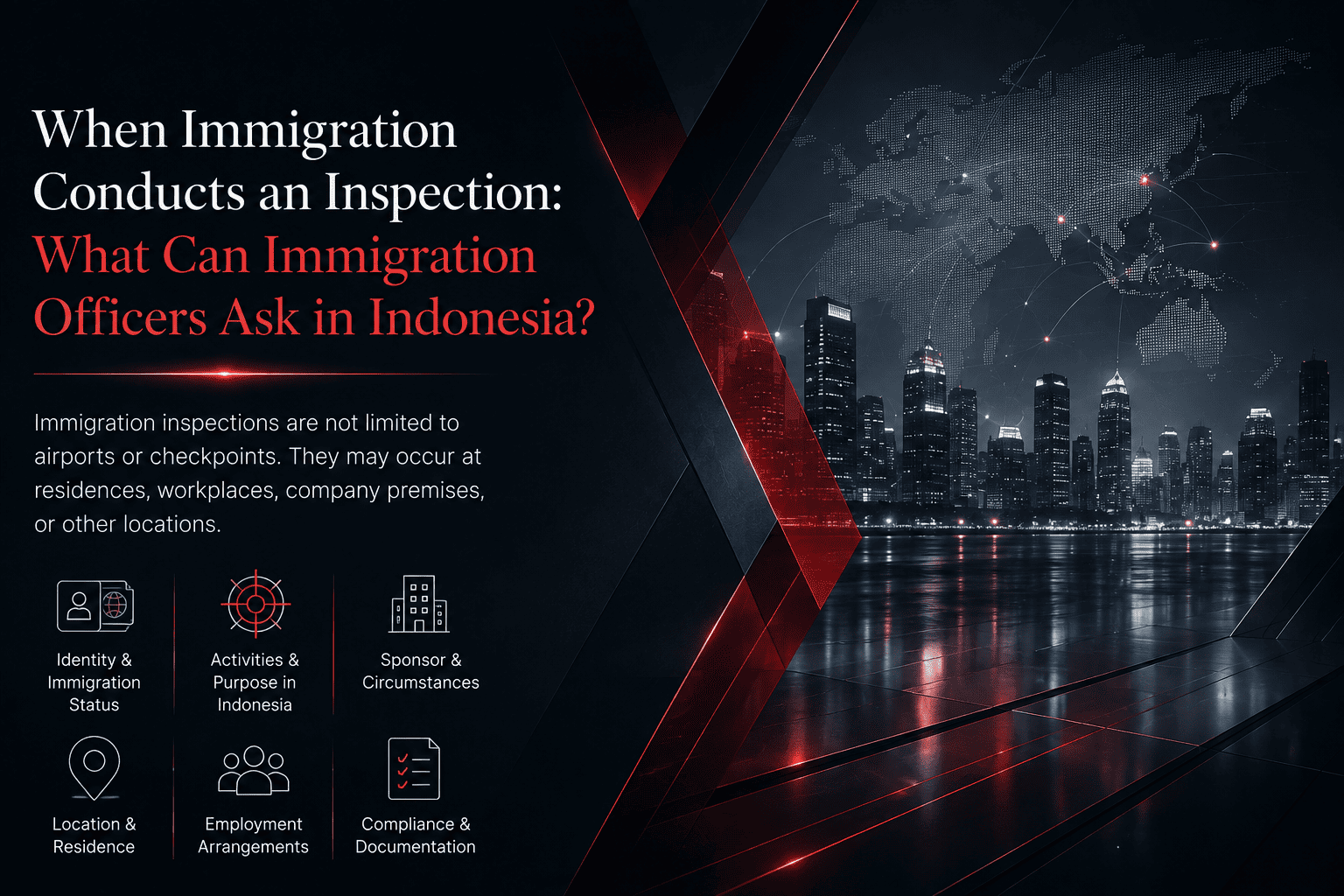
Immigration inspections in Indonesia do not always take place at airports or other immigration checkpoints. Immigration supervision may also involve inspections of foreign nationals, residences, workplaces, accommodation, company premises, or other locations relevant to the enforcement of immigration laws. For companies employing foreign nationals, this raises a practical question: what can Immigration Officers actually ask, and how far can an immigration inspection go?
1. An inspection may begin with identity and immigration status
The first point of examination will generally be the foreign national’s identity and immigration status. Immigration Officers may request a passport, Stay Permit, or other relevant immigration documents and verify the information against immigration records. Questions may cover the foreign national’s full name, nationality, date and place of birth, address, date of arrival in Indonesia, type of Stay Permit, Sponsor, and the basis for their presence in Indonesia.
The purpose is not simply to establish that a document exists. Immigration may also assess whether the document remains valid, whether the information remains accurate, and whether the foreign national’s actual circumstances correspond with the information recorded in the immigration system. Accordingly, a foreign national who has changed residence, Sponsor, or other relevant circumstances may be asked to explain the change and whether it has been reported or reflected in the relevant immigration records.
2. Immigration may ask what the foreign national is actually doing in Indonesia
The foreign national’s purpose and activities in Indonesia may form an important part of an inspection. An Immigration Officer may ask where the person works, what position they hold, what activities they perform, for whom those activities are undertaken, and how long they have been carrying them out. Questions may also concern where those activities take place, particularly where the foreign national is working or undertaking activities subject to immigration or employment requirements.
This is important because immigration compliance is not determined solely by the label attached to a visa or Stay Permit. Immigration may assess whether the activities actually undertaken by the foreign national are consistent with the purpose and conditions attached to their immigration status. Where an inspection reveals that the actual activities materially differ from those reflected in the relevant immigration documents or records, the matter may warrant further examination.
3. Questions may extend to the Sponsor and the foreign national’s circumstances
Where a foreign national has a Sponsor in Indonesia, Immigration may also seek information concerning the Sponsor and the basis of the sponsorship arrangement. Questions may concern who the Sponsor is, the relationship between the Sponsor and the foreign national, the activities or employment undertaken, and whether the circumstances underlying the sponsorship remain consistent with the actual situation.
This is particularly relevant where the Sponsor is a corporate entity. Indonesia’s Immigration Law places certain responsibilities on Sponsors in relation to the foreign nationals they sponsor. An inspection may therefore examine not only the foreign national’s documents, but also whether the Sponsor’s information and the foreign national’s actual circumstances remain consistent with the immigration records. For companies, the implication is clear: immigration compliance is not solely the responsibility of the foreign employee.
4. The location where the foreign national is found may also become relevant
The location at which a foreign national is found may itself become relevant to an inspection. Depending on the circumstances, Immigration may seek to establish whether the foreign national actually resides at the recorded address, works at the stated location, or is undertaking activities at a place consistent with their immigration and employment arrangements.
For foreign workers, this distinction matters. A company may maintain complete immigration documentation while the foreign worker is, in practice, working at a project site, branch office, client premises, vessel, or another location that has not been assessed against the applicable foreign worker arrangements. Similarly, a foreign national may be residing at an address different from the information recorded with Immigration. These circumstances do not automatically establish a violation, but they may provide grounds for Immigration to seek further explanations and conduct additional verification.
5. Immigration may ask about the foreign worker’s employment arrangements and activities
Where an inspection concerns a foreign worker, the questions may extend into the individual’s employment relationship. Immigration may request information concerning the employer, position, duties, work location, length of employment, supervisor, and nature of the activities being undertaken. The foreign national may also be asked to identify their supervisor, colleagues, project, or other circumstances relevant to establishing their actual activities in Indonesia.
This is where immigration and employment compliance may intersect. The key issue is whether the actual employment circumstances remain consistent with the foreign national’s immigration position and applicable foreign worker arrangements. A discrepancy between the position stated in the documents, the work actually performed, the work location, and the supporting records may lead to further scrutiny. An immigration inspection should therefore not be treated merely as a document-production exercise; the facts on the ground must also be capable of being accurately explained and substantiated.
6. What should companies do when Immigration conducts an inspection?
The appropriate response is not to attempt to script answers for Immigration or formulate explanations only after an inspection has begun. The more important step is to ensure in advance that the company’s foreign worker records accurately reflect the actual circumstances. This includes maintaining consistency between immigration documents, Sponsor information, residence, employment arrangements, position, work location, and the foreign national’s actual activities.
When an inspection takes place, the company should also ensure that relevant personnel understand who is responsible for communicating with Immigration, that requested documents can be produced accurately, and that explanations provided by the company and the foreign national are consistent with the underlying facts and records. Where an issue is unclear or may have material consequences, the company should consider obtaining appropriate immigration or legal advice rather than providing speculative explanations.
Conclusion
Immigration inspections in Indonesia are not limited to checking whether a foreign national holds a valid passport or Stay Permit. Depending on the circumstances, Immigration may examine identity, immigration status, residence, Sponsor, employment relationship, work location, activities, and other facts relevant to immigration supervision. Where an initial inspection identifies an inconsistency or concern, the examination may develop into a more detailed process.
How TAMA Global Mobility Can Support
TAMA Global Mobility supports multinational companies, foreign investors, employers, HR teams, and foreign nationals in navigating Indonesian immigration and Global Mobility matters, including immigration inspections, foreign worker compliance, Sponsor obligations, and complex immigration issues.
Our services may include:
- assessing a company’s and foreign national’s readiness for an immigration inspection;
- reviewing the consistency between immigration records and the foreign national’s actual circumstances, including residence, Sponsor, employment, position, and activities;
- assessing potential immigration and foreign worker compliance issues arising from an inspection;
- reviewing the relationship between the foreign national’s actual activities and their applicable immigration status;
- assessing potential inconsistencies between immigration, employment, and foreign worker documentation;
- assisting companies in responding to immigration inquiries and inspection-related issues; and
- providing strategic advisory on complex immigration matters that may arise from immigration supervision or enforcement.
TAMA Global Mobility helps international companies, employers, and foreign nationals navigate the intersection between immigration status, foreign worker regulation, and actual activities in Indonesia, ensuring that the immigration structure is aligned with the circumstances on the ground and the applicable Indonesian regulatory framework.
Disclaimer: Here
– – – ||| – – –
TAMA Global Mobility
WhatsApp: +62 821-1015-402
Email: info@tamaglobalmobility.com
For additional insights on Indonesian immigration compliance and global mobility matters, explore our related publications:
Change of Address in Indonesia: Immigration Reporting Obligations for Foreign Workers (TKA)
Foreign Artists Performing in Indonesia: When Is a Work Permit Required?
Indonesia’s 2026 Draft Manpower Bill: Key Considerations for Employers of Foreign Workers