
07 Jun 2026 · TAMA Insight
Blacklisted by Indonesian Immigration: Understanding Re-Entry Restrictions and International Workforce Mobility Risks
As international workforce mobility continues to increase across Southeast Asia, multinational organisations are increasingly encountering situations involving foreign nationals who have previously been subject to Indonesian immigration enforcement…
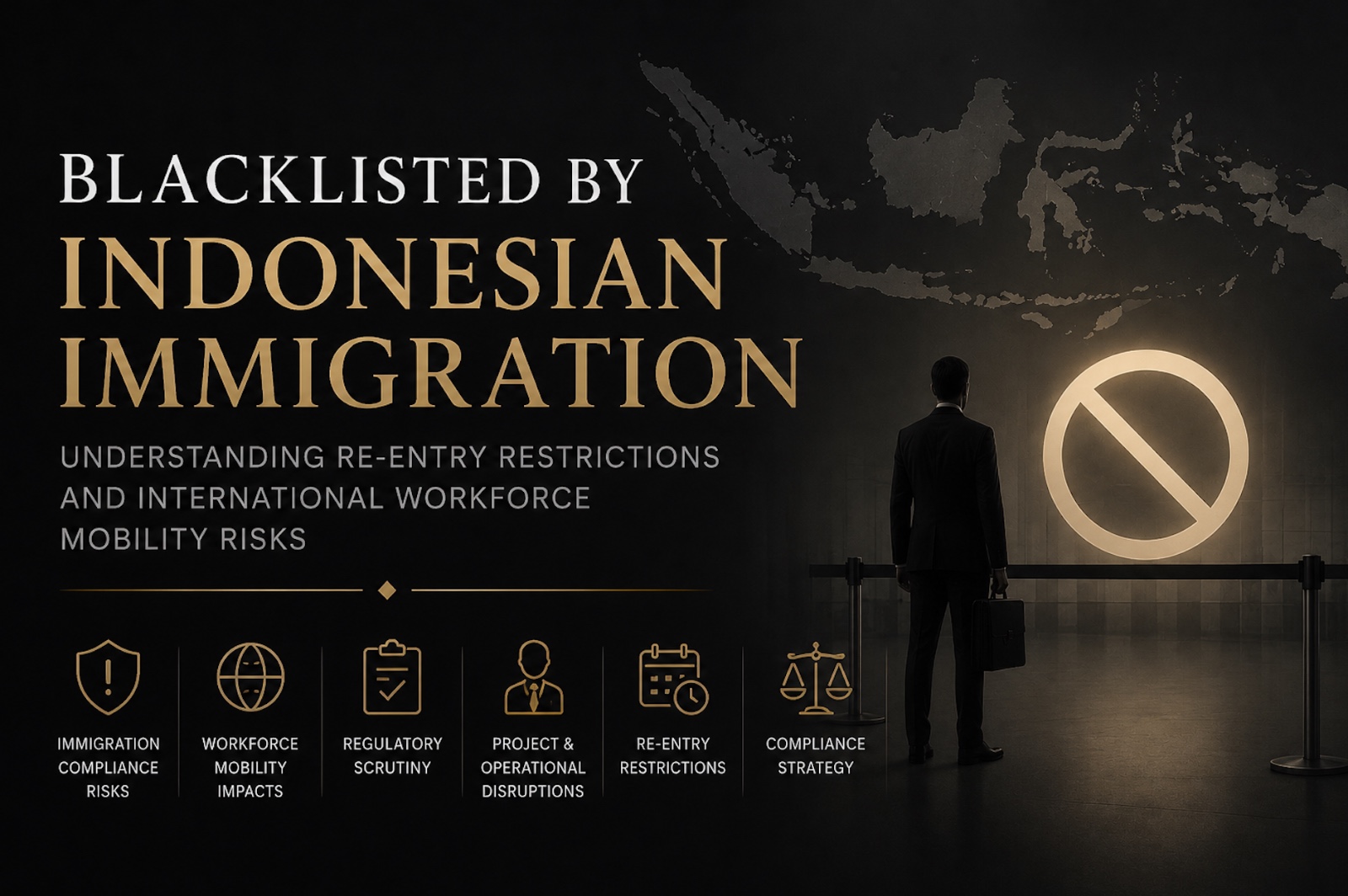
As international workforce mobility continues to increase across Southeast Asia, multinational organisations are increasingly encountering situations involving foreign nationals who have previously been subject to Indonesian immigration enforcement measures.
One of the most significant immigration consequences arising from non-compliance with Indonesian immigration regulations is the imposition of re-entry restrictions, commonly referred to as an Indonesian immigration blacklist.
Whether resulting from deportation, immigration violations, overstay situations, or other administrative enforcement measures, re-entry restrictions may have significant implications for business travel, project deployment, technical assignments, investment activities, and cross-border workforce mobility.
For employers, immigration blacklisting should not be viewed solely as an issue affecting an individual foreign employee. Rather, it represents a broader compliance and operational risk that may impact global workforce planning, strategic project implementation, and business continuity.
Understanding Re-Entry Restrictions Under Indonesia’s Immigration Framework
Under Indonesia’s immigration framework, foreign nationals may become subject to re-entry restrictions that limit or prohibit their entry into Indonesia for a specified period.
From a practical perspective, re-entry restrictions serve as one of the regulatory tools available to immigration authorities to manage immigration-related risks and enforce compliance with applicable laws and regulations.
As a result, even where an individual has a legitimate business purpose, investment interests, or otherwise satisfies certain administrative requirements, inclusion on a re-entry restriction list may prevent that individual from entering Indonesia while the restriction remains in effect.
Circumstances Commonly Leading to Re-Entry Restrictions
Although every case is assessed based on its specific facts and circumstances, re-entry restrictions commonly arise in situations involving:
- Deportation resulting from immigration violations;
- Significant overstay situations;
- Misuse of visa categories or immigration permissions;
- Activities inconsistent with visa or stay permit conditions;
- Compliance issues identified during immigration inspections, audits, or enforcement activities; and
- Other circumstances considered relevant by the competent authorities.
Importantly, immigration exposure frequently arises not from deliberate misconduct, but from misunderstandings regarding the appropriate immigration pathway for a particular assignment.
This situation commonly occurs where foreign specialists enter Indonesia under business or visit visa arrangements but subsequently undertake activities that may be regarded as work under Indonesia’s immigration and manpower framework.
Implications for Employers and Multinational Organisations
The consequences of re-entry restrictions often extend far beyond the affected individual.
For multinational organisations, restrictions on future entry may create substantial operational challenges, particularly where the individual concerned plays a critical role in:
- Technical projects;
- Engineering assignments;
- Aircraft maintenance operations;
- Manufacturing activities;
- Energy and infrastructure projects; and
- Investment implementation initiatives.
Potential consequences may include:
- Delays to project execution;
- Disruption of technical support activities;
- Interruption of maintenance schedules;
- Constraints on international workforce mobility;
- Increased regulatory scrutiny;
- Additional compliance reviews; and
- Risks to business continuity.
In industries heavily dependent on foreign expertise, including aviation, manufacturing, mining, energy, technology, and infrastructure, the inability to deploy key personnel may have significant commercial implications.
Can an Individual Subject to Re-Entry Restrictions Return to Indonesia?
One of the most frequently raised questions concerns whether a foreign national who has been subject to a re-entry restriction may subsequently return to Indonesia.
The answer depends on a number of factors, including:
- The individual’s immigration history;
- Previous immigration enforcement actions;
- Applicable regulatory requirements;
- The duration of the re-entry restriction imposed; and
- Relevant policy considerations at the time of assessment.
Each case requires an individual assessment of the underlying facts and immigration history.
However, under the Indonesian immigration framework, a re-entry restriction may cease to apply where:
- The prescribed restriction period has expired;
- The restriction is revoked by the Minister; or
- The individual has fulfilled the obligation to pay any applicable immigration charges, administrative fees, or penalties imposed as part of an Immigration Administrative Action.
Workforce Mobility and Risk Management Considerations
As regulators across various jurisdictions continue to place greater emphasis on immigration compliance, organisations should adopt a proactive approach to managing immigration-related risks.
Particular attention should be given to:
- Immigration category assessments;
- Visa classification reviews;
- Sponsor compliance obligations;
- Immigration reporting requirements;
- International workforce mobility governance;
- Assignment structure evaluations;
- Immigration audit preparedness; and
- Immigration inspection readiness.
In many situations, conducting a pre-deployment immigration compliance review represents one of the most effective methods of reducing enforcement exposure while protecting business continuity.
TAMA Global Mobility Perspective
Re-entry restrictions imposed by Indonesian Immigration should not be viewed merely as limitations on an individual’s ability to enter Indonesia.
For multinational organisations, they represent compliance, operational, and workforce mobility risks that may affect project execution, international assignments, and broader business objectives.
As immigration enforcement practices continue to evolve, organisations that regularly deploy foreign personnel to Indonesia should ensure that immigration compliance forms an integral part of their corporate governance, risk management, and global mobility strategy.
How TAMA Global Mobility Can Help
TAMA Global Mobility assists multinational corporations, foreign investors, aviation operators, engineering contractors, manufacturing companies, energy companies, technical service providers, and international organisations in identifying and managing immigration compliance risks in Indonesia.
Our services include:
- Immigration Compliance Review;
- Immigration Risk Assessment;
- Workforce Mobility Compliance Advisory;
- Immigration Inspection Readiness Assessment;
- Visa and Work Permit Strategy Review;
- Sponsor Compliance Assessment; and
- Strategic Advisory for Complex Immigration Matters.
Through a compliance-focused and risk-based approach, we help organisations identify potential immigration exposure at an early stage before it develops into a more complex regulatory or operational issue.
Disclaimer: Here
– – – ||| – – –
TAMA Global Mobility
WhatsApp: +62 821-1015-402
Email: info@staging.tamaglobalmobility.com
We would be pleased to discuss your requirements and assist with the assessment of appropriate immigration pathways for your personnel.
For additional insights on Indonesian immigration compliance and global mobility matters, explore our related publications:
Overstaying More Than 60 Days in Indonesia: Deportation Risks, Blacklisting, and Key Considerations
Can Foreign Nationals Work in Indonesia Without Employer Sponsorship?
Who Can Sponsor a Visa in Indonesia? An Immigration Compliance and Global Mobility Perspective