
01 Aug 2026 · TAMA Insight
Indonesia’s Trademark Fee Increase Signals More Than Higher Costs: Why Foreign Investors Should Integrate Immigration Strategy into Market Entry Planning
Indonesia’s Investment Environment Continues to Evolve Effective in early August 2026, the Indonesian Government has introduced higher government fees for trademark registration and renewal under Government Regulation…
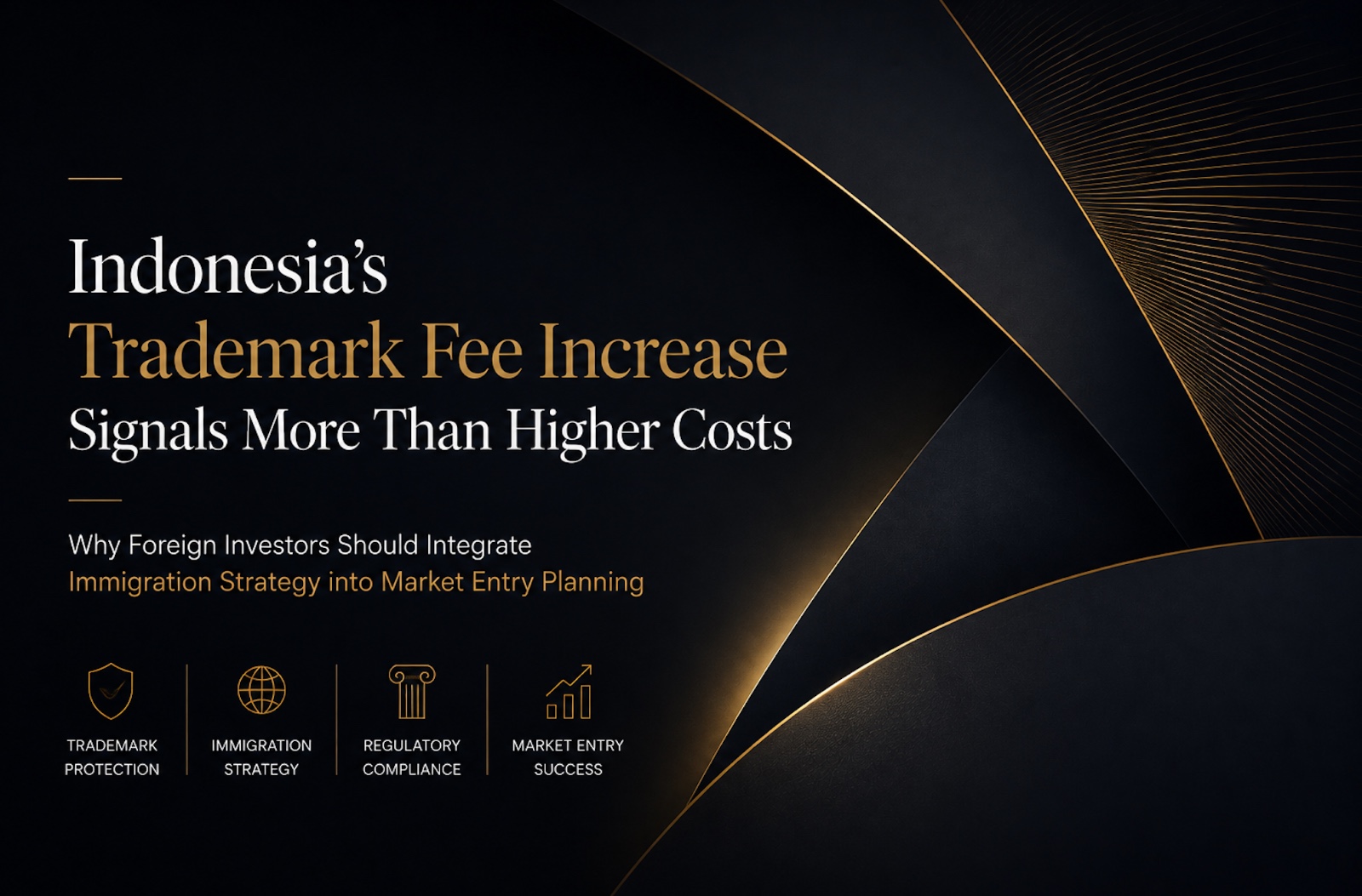
Indonesia’s Investment Environment Continues to Evolve
Effective in early August 2026, the Indonesian Government has introduced higher government fees for trademark registration and renewal under Government Regulation No. 30 of 2026 (PP No. 30/2026).
For general applicants, the adjustment represents a significant increase across all trademark services:
- Trademark filing increases from Rp 1,800,000 to Rp 2,800,000 per class (+55.6%).
- On-time trademark renewal increases from Rp 2,250,000 to Rp 3,500,000 per class (+55.6%).
- Renewal during the grace period increases from Rp 4,500,000 to Rp 7,000,000 per class (+55.6%).
While much of the discussion surrounding PP No. 30/2026 focuses on increased intellectual property costs, the broader commercial significance extends beyond trademark protection itself.
For multinational companies, foreign investors, and internationally active businesses, trademark registration frequently forms part of a much larger investment and expansion strategy into Indonesia.
Trademark Registration Often Marks the Beginning of Business Expansion
Businesses rarely register trademarks simply to own intellectual property.
In practice, trademark filings commonly accompany broader commercial activities such as:
- establishing an Indonesian subsidiary (PT PMA);
- launching products or services in Indonesia;
- relocating regional executives;
- appointing foreign directors or commissioners;
- transferring technical specialists;
- expanding regional operations;
- securing long-term investments.
In other words, trademark protection often represents one of the earliest legal steps in entering the Indonesian market.
As investment activities increase, businesses simultaneously become subject to multiple regulatory frameworks, including corporate licensing, employment regulations, taxation, and immigration compliance.
Successful market entry therefore depends not only on protecting intellectual property, but also on ensuring that the people responsible for operating the business can legally live and work in Indonesia.
Intellectual Property Protects Commercial Assets. Immigration Protects Business Operations.
Most international businesses understand the importance of protecting trademarks.
However, commercial success ultimately depends on people.
Foreign investors require appropriate investor immigration arrangements.
Regional executives require lawful work authorization.
Foreign directors must understand the immigration implications of their appointments.
Technical specialists require appropriate permits before commencing operational activities.
Senior management may relocate with accompanying family members who also require long-term immigration solutions.
Accordingly, protecting business assets and protecting business mobility should be viewed as complementary components of an effective market entry strategy.
A registered trademark protects the company’s brand.
An effective immigration strategy protects the company’s ability to execute its business plans.
Regulatory Complexity Increases Alongside Investment
Indonesia continues to attract multinational corporations, manufacturing companies, technology businesses, private investors, family offices, and high-net-worth individuals seeking opportunities across Southeast Asia.
As investment activity grows, regulatory expectations continue to evolve.
Companies expanding into Indonesia often need to coordinate multiple workstreams simultaneously, including:
- company establishment;
- business licensing;
- trademark protection;
- executive relocation;
- foreign workforce planning;
- investor immigration;
- long-term residency arrangements;
- immigration compliance;
- ongoing regulatory reporting.
Each process is governed by different authorities, yet all contribute to the same commercial objective.
Where one element is delayed or overlooked, the broader implementation timeline may also be affected.
Immigration Should Be Planned Before Executives Arrive
Many businesses only begin considering immigration after commercial decisions have already been made.
In practice, immigration considerations often arise much earlier.
Questions frequently include:
- Can foreign directors immediately work after incorporation?
- Which activities may be conducted under an investor stay permit?
- When is a work permit required?
- Can executives supervise multiple affiliated entities?
- How should companies manage future transfers of expatriate employees?
- What immigration implications arise from corporate restructuring?
Addressing these questions at an early stage enables businesses to implement expansion plans more efficiently while reducing unnecessary regulatory uncertainty.
Immigration planning therefore functions as a strategic component of investment implementation rather than a purely administrative process.
Governance Rather Than Administrative Processing
As Indonesia’s regulatory environment becomes increasingly sophisticated, successful market entry requires coordination between multiple professional advisers.
Corporate lawyers establish legal entities.
Intellectual property advisers protect commercial assets.
Tax advisers structure investments.
Employment advisers support workforce planning.
Immigration advisers ensure that internationally mobile individuals can legally support business operations within Indonesia.
Viewed collectively, these disciplines strengthen corporate governance and contribute to more sustainable business expansion.
Indonesia Continues to Attract Global Investors
The increase in trademark fees should not necessarily be viewed as a barrier to investment.
Rather, it reflects Indonesia’s continued development of its regulatory framework alongside growing commercial activity.
For large multinational corporations and institutional investors, the additional government filing fees are unlikely to alter investment decisions.
Instead, the greater challenge often lies in coordinating multiple regulatory requirements efficiently during market entry.
Businesses that integrate intellectual property protection, corporate structuring, licensing, and immigration planning at an early stage are generally better positioned to execute their expansion strategies while maintaining regulatory compliance.
How TAMA Global Mobility Can Assist
For many multinational companies and foreign investors, protecting intellectual property is only one component of establishing a successful presence in Indonesia. Commercial expansion often requires businesses not only to secure their trademarks and other intellectual property rights, but also to relocate key personnel, appoint foreign directors, deploy technical specialists, and establish an immigration framework that supports lawful business operations.
TAMA Global Mobility assists clients in adopting an integrated market entry approach by aligning intellectual property protection with immigration strategy and broader regulatory compliance.
Our advisory services include:
- Trademark registration and intellectual property portfolio advisory;
- Immigration planning for foreign investors, directors, executives, and key personnel supporting business expansion;
- Immigration strategy aligned with intellectual property commercialisation and business operations;
- Corporate immigration governance and compliance;
- Long-term residency and executive mobility planning;
- Corporate licensing and regulatory advisory; and
- Strategic advisory for complex cross-border investment and market entry projects.
By integrating intellectual property protection with immigration and regulatory strategy, we help businesses protect both their commercial assets and the people responsible for creating, managing, and expanding those assets in Indonesia.
Disclaimer: Here
– – – ||| – – –
TAMA Global Mobility
WhatsApp: +62 821-1015-402
Email: info@staging.tamaglobalmobility.com
For additional insights on Indonesian immigration compliance and global mobility matters, explore our related publications:
Can Your Company Be Sanctioned for Improperly Sponsoring a Foreign Worker?
A Foreign Employee Has Been Reported to Indonesian Immigration: What Happens Next?