19 Sep 2026 · TAMA Insight
Manufacturer’s Support Letter in Indonesia: When Is It Required and What Are the Legal Consequences?
A manufacturer’s support letter is a document commonly used in Indonesia to demonstrate that a manufacturer or principal provides support to a distributor, agent, supplier, or specific tender…
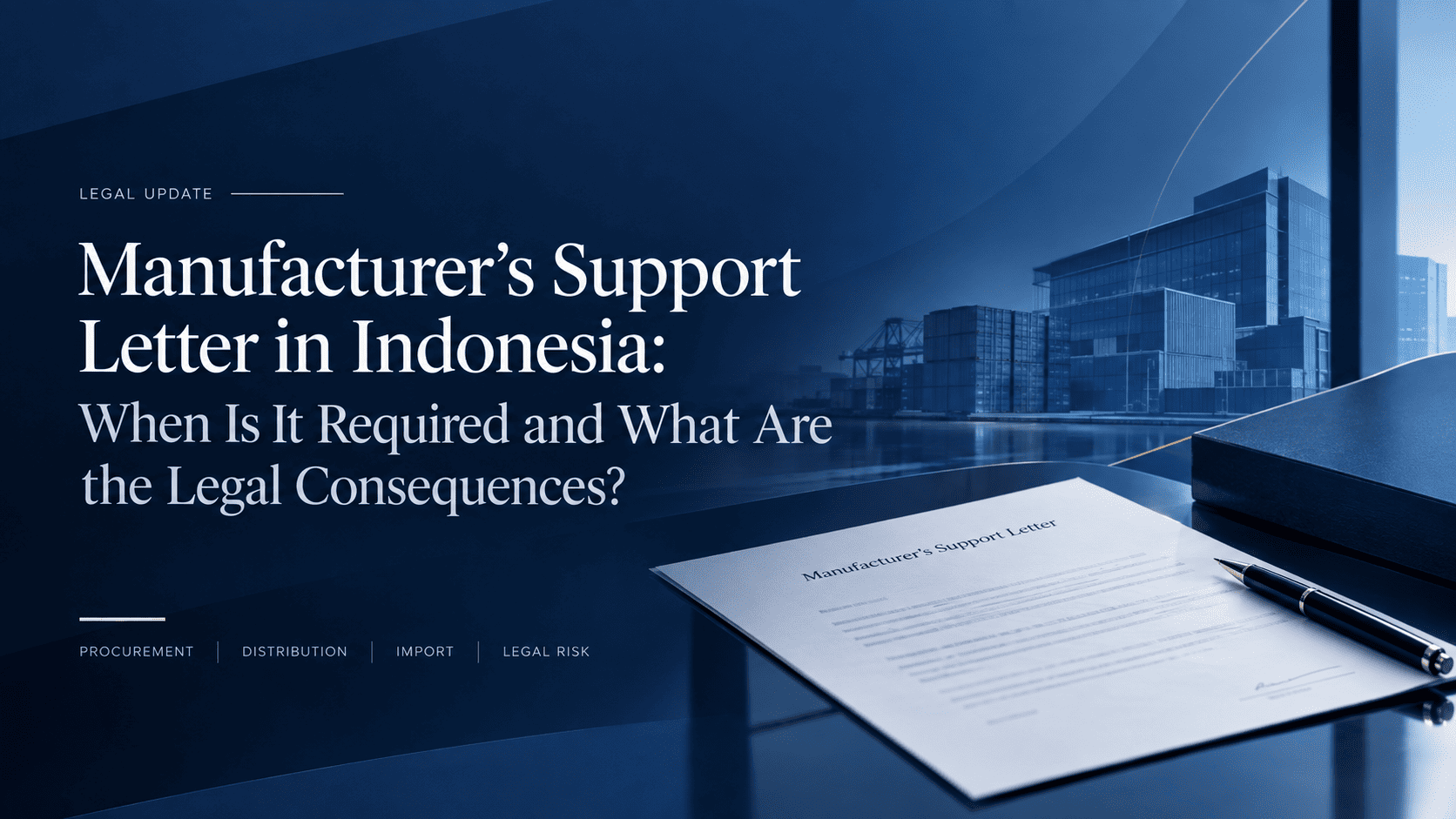
A manufacturer’s support letter is a document commonly used in Indonesia to demonstrate that a manufacturer or principal provides support to a distributor, agent, supplier, or specific tender participant in connection with the provision of certain goods or services.
Depending on its contents and purpose, the letter may state that a company is an authorized distributor, confirm the availability of products or spare parts, provide technical and after-sales support, or authorize a particular party to participate in a tender or conduct a commercial transaction.
However, a manufacturer’s support letter is not a standalone legal instrument specifically regulated under a single law or regulation in Indonesia. Its legal status depends on the context in which it is issued and used.
In practice, legal consequences may arise under contract law, government procurement regulations, consumer protection laws, business licensing and import regulations, as well as criminal law where the document contains false information or is used unlawfully. Accordingly, the key question is not merely whether a manufacturer’s support letter is required, but also what the letter states, who relies on it, and what obligations are expressly or implicitly assumed by the manufacturer and the recipient.
When Is a Manufacturer’s Support Letter Required?
A manufacturer’s support letter commonly arises in several types of transactions and business activities in Indonesia.
1. Government Procurement
In government procurement, a manufacturer’s support letter may be required where the procurement documents require tender participants to demonstrate support from the manufacturer or principal.
This is particularly relevant for imported goods, specialized goods, or products with specific technical characteristics, including equipment, machinery, information technology products, infrastructure systems, and other products for which certainty regarding product authenticity, product availability, technical support, or after-sales services is important.
The current framework for government procurement is primarily governed by Presidential Regulation No. 16 of 2018, as amended most recently by Presidential Regulation No. 46 of 2025. Presidential Regulation No. 46 of 2025 has been effective since 30 April 2025.
These procurement provisions are further implemented through relevant regulations issued by the National Public Procurement Agency (LKPP) and the applicable procurement documents.
It is important to note that a manufacturer’s support letter is not automatically required in every government procurement process. Whether it is required depends on the procurement method, the procurement object, and the requirements stipulated in the applicable procurement documents.
In certain procurement documents, LKPP documents expressly recognize documents such as a Supporting Letter, Letter of Intent, or Letter of Agreement from the manufacturer or principal in the country of origin. In certain procurement models, such documents may be required for imported goods and form part of the bid submission where stipulated in the procurement documents.
In practice, such documents may be used to demonstrate:
a. the authenticity and origin of the goods;
b. the relationship between the tender participant and the manufacturer or principal;
c. product availability;
d. technical support and after-sales services;
e. availability of spare parts;
f. warranty or maintenance support; and
g. the manufacturer’s willingness to support the participant in performing the procurement contract.
Accordingly, tender participants should carefully review the Instructions to Participants, procurement specifications, evaluation criteria, and other applicable procurement documents before determining whether a manufacturer’s support letter is mandatory.
Where a manufacturer support document is expressly required as part of the bid submission, failure to provide a valid document may affect the participant’s compliance with the applicable administrative or technical requirements.
2. Distributor and Agent Relationships with Manufacturers
A manufacturer’s support letter is also commonly used in private-sector transactions involving manufacturers, principals, distributors, agents, and resellers.
For example, an Indonesian distributor may request a letter from a foreign manufacturer confirming that:
a. the Indonesian company is an authorized distributor;
b. the company is authorized to market or sell certain products;
c. the manufacturer will supply the relevant products; the manufacturer will provide technical assistance;
d. spare parts will be available; or
e. after-sales support and warranty services will be provided.
In this context, a support letter may serve as evidence of a commercial relationship between the manufacturer and the distributor.
However, the legal consequences of the letter depend significantly on its wording.
A document merely stating that the manufacturer “supports” a distributor has different implications from a document stating that the manufacturer “undertakes to supply certain goods, guarantee the availability of spare parts for a specified period, provide warranty support, or assume certain obligations.”
This distinction is important because the more specific and unconditional the statement, the stronger the basis for treating the manufacturer as having assumed an obligation that may be legally enforceable.
3. Import and Industrial Transactions
Manufacturer support documents may also become relevant in transactions involving imported products and industrial activities.
For certain products and procurement structures, an importer or supplier may be required to demonstrate its relationship with the manufacturer or principal through documents such as an appointment letter, supporting letter, letter of authorization, or similar documentation.
The specific requirements depend on the type of product, sector, import mechanism, and applicable technical regulations.
Accordingly, a manufacturer’s support letter should not automatically be treated as a universally applicable import requirement.
A company should first determine whether the relevant customs, trade, industrial, technical, or sector-specific framework requires evidence of a formal relationship between the Indonesian importer or distributor and the foreign manufacturer.
This becomes particularly important for specially regulated products or products with specific technical characteristics, where Indonesian authorities may require evidence regarding the origin of the goods, authorization, technical specifications, or availability of after-sales services.
4. Product Authenticity and After-Sales Support
In commercial transactions, a manufacturer’s support letter may also be used to demonstrate that products offered by a distributor or seller originate from an authorized distribution channel.
This may be particularly relevant for:
a. high-value equipment;
b. industrial machinery;
c. electronic products;
d. medical or technical equipment;
e. specialized infrastructure products; and
f. products requiring specialized maintenance or spare parts from the manufacturer.
From a consumer protection perspective, businesses must ensure that the products and information provided to consumers comply with the applicable requirements in Indonesia.
Accordingly, a manufacturer’s support letter should not be used to communicate to consumers any rights or warranties that are not actually stated in or supported by the document.
What Is the Legal Status of a Manufacturer’s Support Letter?
The legal status of a manufacturer’s support letter depends on the contents of the letter, the parties involved, and the circumstances in which the letter was issued.
A support letter may function as:
a. evidence of authorization or a commercial relationship;
b. evidence supporting the technical or commercial qualifications of a tender participant;
c. a statement of the manufacturer’s intention to support a transaction; or
d. in certain circumstances, a source of contractual obligations.
Accordingly, the title “Manufacturer’s Support Letter” does not, by itself, determine the legal status of the document.
1. Potential Basis for Contractual Obligations
Under Indonesian civil law, contractual relationships generally arise where the requirements for a valid agreement are satisfied.
Accordingly, where a support letter contains sufficiently clear commitments, is issued by an authorized party, is addressed to an identifiable party, and demonstrates an intention to create binding obligations, its contents may potentially serve as the basis for a legally binding relationship.
This is particularly relevant where the letter contains commitments to:
a. supply specific products;
b. maintain product availability;
c. provide spare parts for a specified period;
d. provide technical assistance;
e. provide warranty services;
f. support the distributor during a tender process; or
g. authorize the recipient to represent itself as an authorized distributor.
However, not every support letter automatically constitutes a standalone agreement.
For example, a letter merely stating that the manufacturer is “willing to provide support” may have different legal consequences from a letter containing an unconditional commitment to supply products and provide after-sales services.
Accordingly, the wording of the letter is critical.
2. Potential Liability for Breach of Contract
Where a manufacturer provides a sufficiently clear and binding commitment but subsequently fails to perform that commitment, the relevant party may consider legal remedies based on breach of contract, depending on the applicable contractual relationship.
For example, a manufacturer may issue a letter expressly stating that it will provide spare parts and technical support for five years in connection with a tender.
If the distributor subsequently wins the tender by relying on that support, but the manufacturer refuses to provide the promised support, the distributor may face contractual exposure toward the end customer while also considering whether it has a legal basis for pursuing claims against the manufacturer.
The allocation of liability will depend on:
a. the contents of the support letter;
b. the distribution or agency agreement;
c. the procurement contract;
d. whether the end customer is a party to, or beneficiary of, the relevant commitment;
e. the authority of the person signing the letter; and
f. the applicable law and dispute resolution mechanism.
3. A Support Letter Does Not Automatically Transfer Liability Under the Main Contract
A manufacturer’s support letter should also be distinguished from the main contract governing the procurement or supply of goods.
Where an Indonesian distributor enters into a procurement contract with a government institution or private purchaser, the distributor will generally remain responsible for performing its obligations under that contract.
The existence of a manufacturer’s support letter does not automatically make the manufacturer a party to the procurement contract.
Accordingly, where the manufacturer is expected to assume specific obligations, those obligations should ideally be clearly documented in the agreement between the manufacturer and distributor and, where appropriate, in the support letter itself.
This is particularly important for:
a. warranty obligations;
b. spare parts supply;
c. delivery commitments;
d. technical support;
e. product replacement;
f. product recalls; and
g. liability for defective products.
Manufacturer’s Support Letter in Government Procurement
Government procurement requires particular attention because a support letter may form part of a bidder’s submission and be evaluated against the procurement documents.
The current government procurement framework primarily consists of Presidential Regulation No. 16 of 2018, as amended by Presidential Regulation No. 12 of 2021 and Presidential Regulation No. 46 of 2025, together with implementing regulations issued by LKPP. Presidential Regulation No. 46 of 2025 is currently in force.
The framework is also supported by LKPP Regulation No. 12 of 2021, as amended by LKPP Regulation No. 4 of 2024.
Where the procurement documents expressly require manufacturer or principal support, tender participants should ensure that the document:
a. is issued by the actual manufacturer or principal;
b. correctly identifies the tender participant;
c. identifies the relevant products or procurement scope;
d. corresponds to the relevant procurement package;
e. remains valid for the required period;
f. is signed by an authorized person;
g. does not contain false or misleading information; and
h. satisfies any legalization, translation, or other formal requirements where required by the procurement documents.
In certain LKPP procurement documents, imported goods may be required to be accompanied by a Supporting Letter, Letter of Intent, or Letter of Agreement from the manufacturer or principal in the country of origin, where such requirement is stipulated in the procurement documents.
This illustrates an important principle: The legal status of a manufacturer’s support letter in government procurement often derives not merely from the name or form of the document, but from the procurement documents that make it part of the bidding requirements.
What Happens If a Manufacturer’s Support Letter Is False or Invalid?
The legal consequences depend on what was falsified or misrepresented, who created or submitted the document, and how the document was used.
1. Consequences in the Procurement Process
Where a tender participant submits a document that does not satisfy the procurement requirements, the participant may face consequences in the procurement process.
Depending on the procurement documents and the nature of the violation, the consequences may include rejection of the bid or the imposition of procurement-related sanctions.
The risk becomes significantly more serious where the document was intentionally falsified or materially misrepresented the tender participant’s relationship with the manufacturer.
Accordingly, tender participants should not treat a manufacturer’s support letter merely as an administrative document.
2. Civil Liability
Where a false statement causes another party to suffer losses, the injured party may consider legal remedies based on the applicable contractual relationship or tort principles, depending on the circumstances.
For example, a distributor may represent itself as an authorized distributor based on a manufacturer’s support letter that was fabricated, after which a customer enters into a transaction relying on that representation.
The distributor may potentially face claims arising from the losses suffered by the customer.
At the same time, a manufacturer whose name, trademark, signature, or corporate identity has been used without authorization may have independent legal grounds to take action against the responsible party.
3. Potential Criminal Consequences
The use of a falsified support letter or a document containing materially false information may also create criminal exposure where the elements of a relevant criminal offense are satisfied.
The analysis cannot automatically be reduced to “a forged letter means fraud.” Criminal liability depends on the specific conduct, intent, method used, resulting consequences, and applicable criminal provisions.
For example, where a falsified support letter is intentionally used as part of a course of conduct to induce another party to transfer money or goods, the conduct may potentially be analyzed under provisions concerning fraud.
The risk may become more serious in government procurement where a falsified document is used to obtain a contract, payment, or other economic benefit.
Accordingly, manufacturers, distributors, and tender participants should verify the authenticity of a support letter and the authority of its issuer before submitting it to a government institution, state-owned enterprise, private purchaser, or other third party.
Risks for Manufacturers
For manufacturers, the primary risk lies in the possibility that a support letter contains commitments broader than those actually intended by the manufacturer.
Accordingly, manufacturers should consider whether the letter:
a. creates an obligation to supply goods;
b. guarantees product availability;
c. guarantees the availability of spare parts;
d. provides a warranty;
e. grants exclusivity rights;
f. authorizes the recipient to represent itself as an authorized distributor;
g. creates direct obligations toward an end customer;
h. applies only to a particular tender or also to future transactions; or
i. remains effective after the relationship with the distributor has ended.
Manufacturers should also ensure that the person signing the letter has appropriate authority.
Where the letter is issued by a foreign manufacturer, additional practical issues may arise concerning:
a. corporate authority;
b. notarization;
c. legalization or apostille, where required;
d. translation into Bahasa Indonesia;
e. validity period;
f. identification of the Indonesian distributor;
g. governing law; and
h. dispute resolution mechanisms.
Accordingly, the support letter should clearly distinguish between commercial support and legally binding commitments.
How TAMA Global Mobility Can Assist
TAMA Global Mobility assists foreign manufacturers, Indonesian distributors, suppliers, and multinational businesses in structuring and reviewing manufacturer support arrangements in Indonesia, including:
a. Manufacturer’s Support Letter Review, reviewing the scope, wording, and validity period of manufacturer support letters;
b. Government Procurement Advisory, advising on manufacturer or principal support requirements under government procurement regulations and applicable procurement documents;
c. Distributor & Agency Structuring, advising on the relationship between foreign manufacturers, principals, Indonesian distributors, agents, and resellers;
d. Contractual Risk Assessment, identifying potential contractual obligations, liability exposure, and inconsistencies between the support letter and the underlying commercial agreements;
e. Import & Regulatory Advisory, analyzing applicable documentation and regulatory requirements for imported products and market entry activities in Indonesia; and
f. Tender Documentation Review, assisting companies in reviewing and preparing supporting documents for government and private-sector tenders.
TAMA Global Mobility provides structured advisory support to foreign companies, manufacturers, distributors, and investors navigating Indonesia’s corporate, licensing, regulatory, procurement, and market-entry environment.
Disclaimer: Here
– – – ||| – – –
TAMA Global Mobility
WhatsApp: +62 821-1015-402
Email: info@tamaglobalmobility.com
For additional insights on Indonesian immigration compliance and global mobility matters, explore our related publications:
Can Foreign AI Companies Offer Services in Indonesia Without a Local Entity?
Centralization of Mining Area Planning for Investigation and Research Assignments in Indonesia
Transfer of ITAS Sponsorship Between Companies Within the Same Business Group in Indonesia
Can Foreign Companies Participate in Government Procurement in Indonesia?
Foreign Founder as a Director of a PT PMA: RPTKA and Work Stay Permit Requirements
Can a Foreign Company Operate in Indonesia Without Establishing a PT PMA?