
13 Aug 2026 · TAMA Insight
Indonesia APEC Business Travel Card (ABTC): Requirements, Application Process, Validity, and Immigration Facilities for Business Travellers
The APEC Business Travel Card (ABTC) is an immigration facilitation scheme that enables business travellers and certain eligible categories of individuals to travel more conveniently to participating APEC…
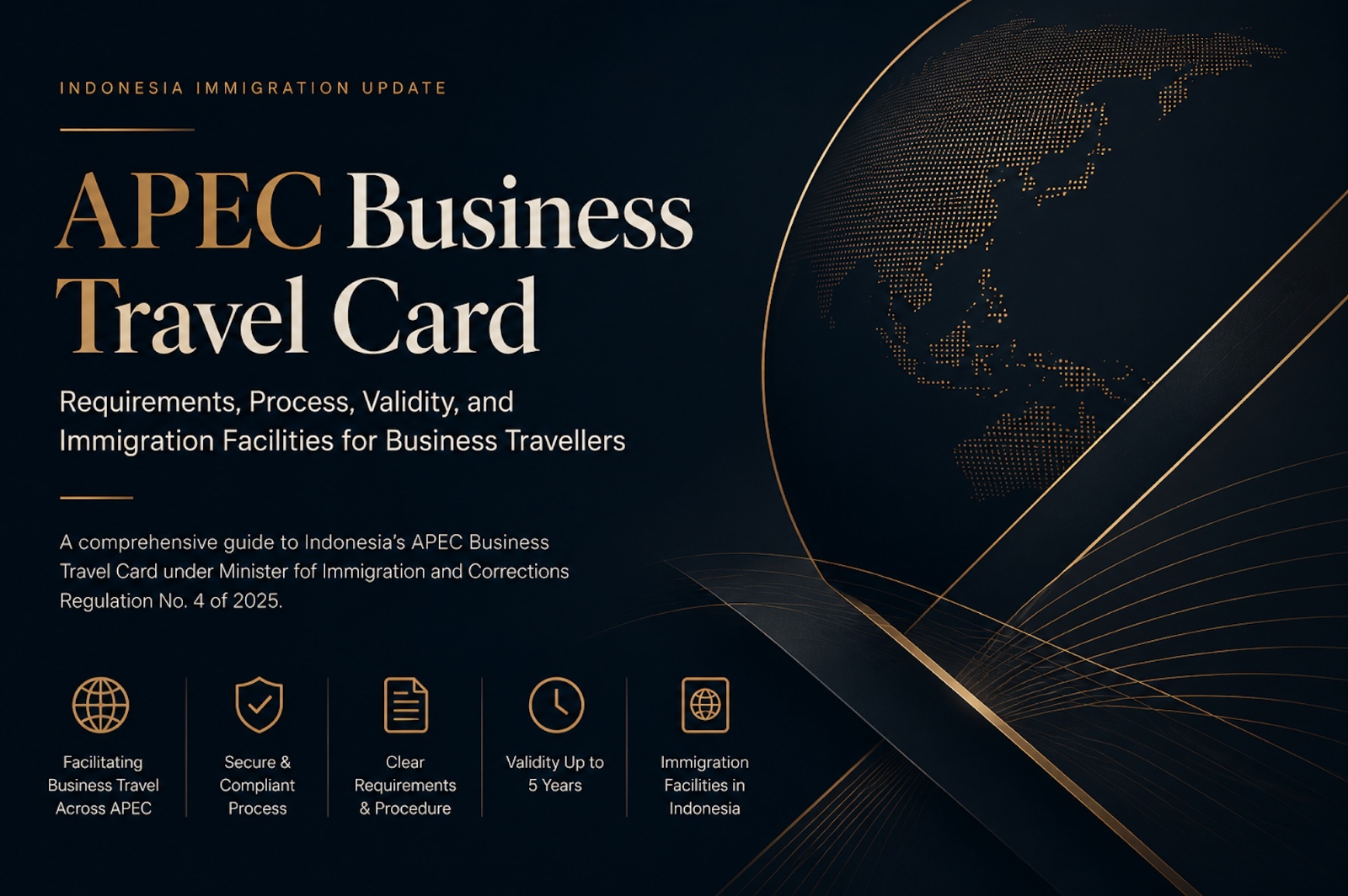
The APEC Business Travel Card (ABTC) is an immigration facilitation scheme that enables business travellers and certain eligible categories of individuals to travel more conveniently to participating APEC economies.
For ABTC holders, the card facilitates international business travel through streamlined immigration procedures and, for ABTC holders issued by certain participating APEC economies, may also serve as a Visit Visa for travel to Indonesia, subject to applicable requirements.
In Indonesia, the ABTC framework is currently regulated under Minister of Immigration and Corrections Regulation No. 4 of 2025 on the APEC Business Travel Card (KPP APEC) (“Regulation 4/2025”).
Regulation 4/2025 updates the previous framework and provides more comprehensive provisions concerning eligibility, application requirements and procedures, validity, data updates, preclearance, and immigration facilities available to ABTC holders entering and departing Indonesia.
1. What Is the APEC Business Travel Card?
The APEC Business Travel Card (ABTC) is a physical or electronic card issued by an authorised official of an APEC member economy. It contains the holder’s identification information and may be used as a basis for travel and stay in participating APEC economies that have granted the relevant approval, in accordance with Regulation 4/2025.
In Indonesia, the ABTC serves as a special immigration facilitation mechanism designed to support the mobility of business travellers and other eligible cardholders who regularly travel to APEC economies.
However, the ABTC is more than simply a travel card. It forms part of an immigration framework involving verification, traveller profiling, preclearance, and information exchange among participating APEC economies.
2. How Does the ABTC System Work?
Regulation 4/2025 establishes several important concepts forming part of the ABTC system.
APEC Business Travel Card
The ABTC is a physical or electronic card containing the holder’s identification information and serving as a basis for travel and stay in APEC economies that have granted approval to the holder.
Preclearance
Preclearance refers to the examination conducted by Immigration Officers in connection with an application for approval to travel to Indonesia.
For ABTC holders whose cards are issued by other APEC economies, preclearance is an important stage that takes place before travelling to Indonesia.
ABTC Software
Regulation 4/2025 also recognises the ABTC Software, an integrated electronic system used for:
- issuing ABTCs;
- replacing ABTCs;
- updating cardholder information;
- card delivery;
- cancellation;
- processing preclearance applications; and
- communicating with other participating APEC economies.
The system is managed by Australia on behalf of APEC economies participating in the ABTC scheme.
Accordingly, the ABTC operates as part of an integrated digital immigration mechanism involving coordination and information exchange among participating economies.
3. Who Can Apply for an ABTC in Indonesia?
Regulation 4/2025 identifies specific categories of Indonesian nationals who may apply for an ABTC.
An ABTC may be applied for by:
- businesspeople from companies operating in Indonesia;
- businesspeople from companies operating outside Indonesia;
- certain professions designated by the Director General of Immigration; and
- government officials at the levels of Minister, Main High Leadership Position, Middle High Leadership Position, and Primary High Leadership Position who are undertaking official duties in APEC economies.
Who Qualifies as a Businessperson?
For businessperson applicants, Regulation 4/2025 provides a more specific definition.
Eligible businesspersons include:
- shareholders;
- directors; and/or
- commissioners.
Such status must be supported by corporate documents, including the company’s deed of establishment, latest deed reflecting the composition of management, or company profile approved or issued by the relevant Minister.
Accordingly, not every employee of a company automatically qualifies to apply for an ABTC under the businessperson category.
4. How Long Is an ABTC Valid?
An ABTC is issued upon application and may be valid for a maximum period of five years under Regulation 4/2025.
An ABTC may be replaced upon expiry. The issuance and replacement of an ABTC are subject to applicable immigration service fees in accordance with the prevailing provisions on Non-Tax State Revenue (PNBP).
Updating ABTC Information
ABTC holders may also request updates to certain information recorded in the system.
Under Regulation 4/2025, permitted updates include:
- changes to the passport number and passport validity period; and
- changes to the registered email address.
Such updates are submitted electronically.
5. What Are the Requirements for an ABTC Application?
An ABTC application must be submitted electronically to the Director General of Immigration or an appointed Immigration Officer.
The applicable requirements may vary depending on the applicant’s category.
In general, supporting documents may include:
- a recommendation or application letter from the relevant company, employer, workplace, or government institution;
- a recommendation letter from a business or professional organisation established as a legal entity, where applicable;
- evidence of the applicant’s personal financial capacity;
- a valid Indonesian passport; and
- other supporting documents required for the relevant applicant category.
Financial Requirement
One requirement that should receive particular attention is the applicant’s financial capacity.
For businesspersons and certain professional categories, Regulation 4/2025 requires evidence of personal financial capacity of at least IDR 1 billion, in the form of savings, deposits, bonds, or mutual funds maintained during the preceding three months.
Passport Validity Requirement
Applicants must also hold a valid Indonesian passport with a remaining validity period of at least 24 months, subject to the applicable requirements for the relevant applicant category.
Certain government officials may be subject to additional requirements, including approval from the Director General of Immigration.
6. What Is the ABTC Application Process?
Once an application has been submitted electronically, the appointed Immigration Officer will conduct a verification process.
In principle, the process includes:
- reviewing the completeness of the supporting documents;
- verifying payment of the applicable service fee;
- conducting applicant profiling; and
- entering the application into the ABTC Software for preclearance processing by other participating APEC economies.
ABTC Profiling
Profiling is an important component of the application process.
Immigration Officers may conduct checks against:
- immigration prevention lists;
- subject-of-interest records;
- immigration service records;
- information obtained from relevant ministries or government institutions;
- information provided by other participating APEC economies; and
- other relevant information.
Where there are concerns regarding the information submitted by an applicant, the Immigration Officer may conduct further investigation or examination.
Accordingly, the accuracy and consistency of information submitted in an ABTC application are important factors in the approval process.
7. When Can an ABTC Application Be Rejected?
An ABTC application may be rejected where the applicant is found to have provided false or inaccurate information.
Under Regulation 4/2025, where false information is identified, the Immigration Officer is required to reject an application for the issuance, replacement, or updating of an ABTC.
The applicant may submit a new application only after six months have passed from the date of rejection.
This requirement highlights the importance of maintaining accurate information and ensuring that the applicant’s supporting documentation is consistent throughout the application process.
8. How Is an ABTC Issued and Cancelled?
The issuance, delivery, and cancellation of an ABTC are conducted electronically through the ABTC Software.
The Director General of Immigration may cancel an ABTC in circumstances including where:
- the holder violates applicable laws and regulations;
- the holder is placed on an immigration prevention list;
- information is received from another participating APEC economy regarding misuse of the ABTC; or
- the relevant company, employer, workplace, or government institution that acted as the sponsor requests cancellation.
Accordingly, an ABTC is not an unconditional immigration privilege. Its validity and use remain subject to applicable regulations and may be reviewed or cancelled where the relevant grounds arise.
9. What Is ABTC Preclearance?
For foreign nationals holding an ABTC issued by another participating APEC economy, Indonesia applies a preclearance mechanism.
Preclearance is an advance approval process conducted before an ABTC holder travels to Indonesia.
Under Regulation 4/2025, the process is conducted through the ABTC Software and includes:
- examination of travel document information;
- profiling and verification; and
- granting of approval.
Profiling may include checks against prevention and deportation lists, subject-of-interest records, immigration service records, and information obtained from relevant ministries, government institutions, and other APEC economies.
Can Preclearance Be Cancelled?
Yes.
Preclearance approval may be cancelled on certain grounds, including matters relating to:
- national security;
- public security and public order;
- criminal offences;
- organised transnational crime;
- prostitution;
- trafficking in persons;
- human smuggling;
- violations of Indonesian laws and regulations; or
- a request from another participating APEC economy.
Depending on the circumstances, cancellation may be carried out by the Director General of Immigration or an appointed Immigration Officer through the ABTC Software.
10. Can an ABTC Replace an Indonesian Visit Visa?
One of the key benefits of the ABTC is that, under certain circumstances, it may function as a Visit Visa for entry into Indonesia.
Under Regulation 4/2025, an ABTC issued by another participating APEC economy that fully participates in the ABTC scheme may serve as a Visit Visa for its holder travelling to Indonesia.
Subject to the applicable requirements, the holder may enter Indonesia for activities including:
- business activities;
- attending meetings;
- purchasing goods;
- tourism; and/or
- transiting to another country.
However, an ABTC cannot be used as a Visit Visa in certain circumstances.
For example, this may apply where:
- the holder uses a travel document different from the document used as the basis for issuing the ABTC;
- the holder is not a national of a fully participating APEC economy;
- the holder is a national of a transitional member economy; or
- the holder has not obtained the required preclearance.
In such circumstances, the foreign national must obtain and use the appropriate visa in accordance with Indonesian immigration regulations.
11. How Long Can an ABTC Holder Stay in Indonesia?
Upon entering Indonesia, an eligible ABTC holder will receive an entry stamp that serves as a Visit Stay Permit.
Under Regulation 4/2025, the Visit Stay Permit is valid for a maximum of 60 days per visit and cannot be extended.
This distinction is important.
An ABTC may have a validity period of up to five years, but this does not mean that the holder may remain in Indonesia continuously for five years.
Rather, the ABTC facilitates repeated business travel, while the permitted period of stay is determined separately for each visit in accordance with Indonesian immigration regulations.
12. Are ABTC Holders Still Subject to Immigration Inspection?
Yes.
Holding an ABTC does not eliminate the requirement to undergo immigration inspection.
ABTC holders entering or departing Indonesia must still undergo immigration examination in accordance with applicable regulations.
However, ABTC holders may benefit from facilitated processing through special immigration counters at Immigration Checkpoints (TPI).
This facility is intended to streamline immigration processing and support business mobility across participating APEC economies.
Do Family Members of ABTC Holders Receive Immigration Facilities?
Yes. Certain facilities may also be extended to family members of ABTC holders.
Under Regulation 4/2025, this may include:
- the holder’s spouse; and/or
- the holder’s children.
Nevertheless, applicable immigration inspection requirements continue to apply.
13. What Documents Must Be Carried When Using an ABTC?
An ABTC holder must carry the travel document used as the basis for issuing the ABTC.
This may include a passport or other valid travel document recognised under the applicable regulations.
Under Regulation 4/2025, the travel document must have a remaining validity period of at least six months when the ABTC holder enters or exits Indonesia.
ABTC holders should therefore ensure that their passport number and passport validity period remain consistent with the information recorded in the ABTC system.
If the holder obtains a new passport, the ABTC information should be updated in accordance with the applicable procedure.
14. What Are the Transitional Provisions for ABTCs?
Regulation 4/2025 also establishes transitional provisions for ABTCs issued under the previous regulatory framework.
ABTCs issued under the previous regulations may continue to be used until their respective expiry dates.
Meanwhile, ABTC applications that had already been submitted and remained under processing before Regulation 4/2025 came into effect continue to be processed under Minister of Law and Human Rights Regulation No. 26 of 2016.
At the same time, Regulation 4/2025 revokes and replaces Minister of Law and Human Rights Regulation No. 26 of 2016 concerning the APEC Business Travel Card.
Accordingly, Regulation 4/2025 currently serves as the principal regulatory framework governing ABTCs in Indonesia.
TAMA Global Mobility Perspective
The APEC Business Travel Card is an important immigration facilitation mechanism designed to support business mobility and cross-border travel throughout the Asia-Pacific region.
For Indonesian nationals, the ABTC may facilitate travel to participating APEC economies. For foreign ABTC holders, the card may, subject to applicable requirements and preclearance, facilitate entry into Indonesia and may serve as a Visit Visa.
However, the ABTC should not be viewed simply as a substitute for ordinary immigration compliance.
Businesses and internationally mobile professionals should consider the interaction between the ABTC and other immigration requirements, including the purpose of travel, permitted activities, duration of stay, passport validity, preclearance status, and applicable Indonesian immigration regulations.
For businesses with executives or personnel who travel frequently across the Asia-Pacific region, understanding these requirements in advance can help minimise immigration risks and ensure that the ABTC is used effectively as part of a broader global mobility strategy.
How TAMA Global Mobility Can Assist
TAMA Global Mobility provides immigration, global mobility, and regulatory advisory services to businesses, executives, and internationally mobile professionals.
In relation to the APEC Business Travel Card, our services may include:
Eligibility Assessment
Assessing whether an individual falls within an eligible category and meets the applicable requirements for an ABTC application.
Application and Documentation Advisory
Advising on the application process and reviewing corporate, financial, passport, and other supporting documentation to ensure that the information submitted is accurate, consistent, and complete.
Preclearance and Entry Advisory
Providing guidance on preclearance requirements and the immigration implications of travelling to Indonesia under the ABTC framework.
Business Travel Compliance
Advising companies and executives on permitted activities, duration of stay, passport requirements, and other immigration considerations applicable to their business travel.
Ongoing Global Mobility Support
Supporting businesses with broader immigration and global mobility matters where frequent international travel forms part of their workforce or business operations.
At TAMA Global Mobility, we take a compliance-driven and advisory approach to immigration. We do not view business travel as an isolated visa matter. Instead, we consider the traveller’s profile, business activities, travel patterns, corporate structure, and broader immigration position to develop a structured and commercially practical mobility strategy.
For companies and executives with regular cross-border activities in the Asia-Pacific region, the ABTC can be a valuable mobility tool, but its benefits are best realised when integrated into a broader and properly managed immigration strategy.
Disclaimer: Here
– – – ||| – – –
TAMA Global Mobility
WhatsApp: +62 821-1015-402
Email: info@staging.tamaglobalmobility.com
For additional insights on Indonesian immigration compliance and global mobility matters, explore our related publications:
Can Foreign Investors Manage Day to Day Business Operations?
Immigration Risks During Mergers and Acquisitions in Indonesia
What Happens If an Indonesian ITAS or ITAP Sponsor Withdraws Its Sponsorship?