
19 Aug 2026 · TAMA Insight
Bringing a Foreign Yacht to Indonesia: A Practical Guide to Temporary Importation, Vessel Declaration and Immigration Compliance
Indonesia, with its extensive coastline and growing marine tourism sector, has become an increasingly attractive destination for foreign yacht owners. However, bringing a foreign yacht into Indonesian waters…
Indonesia, with its extensive coastline and growing marine tourism sector, has become an increasingly attractive destination for foreign yacht owners. However, bringing a foreign yacht into Indonesian waters is not merely a matter of bringing the vessel into Indonesia.
The arrival of a foreign yacht may trigger obligations across several regulatory areas, including customs, immigration, quarantine, and port-related requirements. This becomes particularly relevant where the yacht is intended to remain in Indonesia temporarily while its ownership and registration remain outside Indonesia.
From a customs perspective, Indonesia provides a specific mechanism for foreign yachts through temporary importation using a Vessel Declaration, which, subject to certain conditions, may allow for exemption from import duties, while remaining subject to the requirements governing temporary importation and the obligation to re-export the vessel.
Accordingly, this structure requires proper coordination between the yacht owner, the person authorised by the owner, the Indonesian shipping agent or guarantor, and the relevant government authorities.
1. Status of Foreign Yachts Entering Indonesia
Foreign yachts are subject to a different treatment from vessels that are permanently imported into Indonesia.
Under Minister of Finance Regulation No. 261/PMK.04/2015 on the Temporary Importation of Foreign Tourist Yachts, as amended by Minister of Finance Regulation No. 123/PMK.04/2017 (“PMK 261/2015”), a foreign tourist yacht may be brought into the Indonesian customs territory under a temporary importation regime.
This framework essentially recognises a foreign tourist yacht as a vessel that is registered in a foreign country, owned by a foreign national, and used for non-commercial tourism or racing activities.
This distinction is important because the purpose of the regime is not to transfer ownership of the yacht to Indonesia, but rather to provide a mechanism through which a foreign yacht may enter Indonesian customs territory for a specified period and subsequently be taken out of Indonesia.
The basic structure is therefore:
foreign ownership → temporary importation → re-export.
2. Who May Import a Foreign Yacht into Indonesia?
One of the most important aspects of this regime concerns who acts as the importer.
Under PMK 261/2015, a foreign tourist yacht may qualify for temporary importation facilities where:
- the vessel is registered in a foreign country;
- the vessel is owned in the name of a foreign national; and
- the vessel is imported by the foreign national or their authorised representative.
This has important practical implications.
An Indonesian company assisting with the yacht’s entry does not automatically become the owner or importer of the yacht merely because it facilitates the vessel’s arrival.
Instead, the customs structure preserves ownership of the vessel by the foreign national, while the temporary importation process may be undertaken by the foreign owner or a party duly authorised by that owner.
3. Vessel Declaration as the Principal Document
The principal mechanism for the temporary importation of a foreign yacht is the Vessel Declaration.
Under PMK 261/2015, a Vessel Declaration constitutes a customs declaration used in connection with the temporary importation and re-exportation of foreign tourist yachts and/or their spare parts.
Accordingly, the Vessel Declaration is not merely an administrative document recording the yacht’s presence in Indonesia.
It serves several functions within the temporary importation framework, including as a customs declaration and written undertaking relating to the temporary entry of the vessel.
The importer submits the Vessel Declaration to the relevant Customs Office or designated Customs and Excise official at the yacht’s port of entry. The submission is made through the applicable electronic service system for the temporary importation of foreign tourist yachts.
In practice, the Vessel Declaration System (VDS) is used as an electronic system to facilitate the registration and processing of foreign tourist yachts entering Indonesian territory.
4. Temporary Importation Facilities
One of the principal benefits of this regime is the availability of customs facilities.
A foreign tourist yacht that satisfies the applicable requirements may qualify for exemption from import duties under the temporary importation regime.
In principle, the requirements include:
- the yacht is registered in a foreign country;
- the yacht is owned in the name of a foreign national;
- the yacht is imported by the foreign national or their authorised representative; and
- the yacht complies with the applicable entry and exit requirements.
This regime differs from ordinary importation.
The vessel is not intended to be permanently imported into or retained within the Indonesian customs territory. Rather, the facility is granted on the basis of the vessel’s temporary status, meaning that the yacht must ultimately be taken out of Indonesia in accordance with the applicable requirements.
5. Who Is Responsible for the Customs Guarantee?
The temporary importation regime also involves a customs guarantee mechanism.
Under PMK 261/2015, the importer provides a guarantee for import duties and other state levies that may become payable in connection with the temporary importation.
The guarantee is incorporated into the Vessel Declaration.
This distinction is important because an exemption from import duties does not mean that customs obligations are absolutely extinguished.
Rather, the relevant obligations remain secured through the applicable guarantee mechanism for as long as the temporary importation facility is being utilised.
Accordingly, the parties should clearly establish from the outset:
- who acts as the importer;
- who acts as the authorised representative;
- who is responsible for the customs guarantee;
- who is responsible for the Vessel Declaration; and
- who is responsible for ensuring that the yacht is re-exported.
These roles should not be treated as interchangeable.
6. The Role of an Indonesian Shipping Agent
Customs requirements must be distinguished from port and vessel-service requirements.
Under Minister of Transportation Regulation No. PM 4 of 2022, as amended by PM 14 of 2023, the owner of a foreign tourist yacht entering Indonesian waters is required to have a vessel guarantor.
A vessel guarantor may be:
- a shipping agent;
- a vessel operator; or
- the master of the vessel.
For a shipping agent, the regulation provides that the agent may be:
- a national shipping agency company; or
- a national sea transportation company.
Accordingly, an important distinction must be maintained between the importer for customs purposes and the guarantor or agent for port-related purposes.
An Indonesian company may have a role in facilitating the yacht’s entry without becoming the owner of the yacht.
However, that role must correspond to the capacity and licensing held by the Indonesian company.
7. The Yacht Does Not Become Indonesian-Owned
Another important consideration concerns the ownership and registration status of the yacht.
A yacht entering Indonesia under a temporary importation regime does not become an Indonesian-owned vessel merely because it enters Indonesian territory.
The temporary importation framework, in fact, requires the vessel to remain:
registered in a foreign country and owned by a foreign national.
This is consistent with the nature of temporary importation.
An Indonesian company may act as an agent, guarantor, or authorised representative for particular purposes, but such appointment does not, by itself, transfer ownership of the yacht to the Indonesian company.
Accordingly, the relevant documents and contractual relationships should clearly distinguish between:
Owner
Foreign national
Vessel registration
Foreign country
Flag
Foreign flag
Importer
Foreign national or authorised representative
Indonesian representative/guarantor
Qualified Indonesian party
Customs facility
Temporary importation
8. Immigration Compliance Is a Separate Matter
Customs clearance does not automatically resolve immigration requirements.
This is particularly important for yacht owners and individuals travelling internationally on board the vessel.
Under Presidential Regulation No. 105 of 2015 on the Visit of Foreign Tourist Yachts to Indonesia, foreign tourist yachts, together with their crew and/or passengers, entering Indonesian waters for tourism purposes are provided with facilitation in the areas of:
- customs;
- immigration;
- quarantine; and
- port services.
Nevertheless, crew members and/or passengers remain required to hold the appropriate immigration stay permit in accordance with Indonesian immigration regulations.
Accordingly, the customs status of the yacht and the immigration status of the individuals on board must be analysed as two separate regulatory matters.
A properly completed Vessel Declaration does not automatically regularise the immigration status of every person on board the yacht.
9. The Yacht Must Be Used for Its Permitted Purpose
The temporary importation facility is also subject to restrictions concerning the use of the yacht.
A foreign yacht entering Indonesia for tourism purposes is, in principle, intended for tourism activities and/or racing in Indonesian waters and may not be commercialised or chartered to another party.
PM 4 of 2022, as amended by PM 14 of 2023, also prohibits the replacement of passengers while the yacht is within Indonesian waters, except in emergency circumstances in accordance with the applicable requirements.
This becomes particularly important where the owner intends to use the yacht for:
- charter activities;
- commercial passenger transportation;
- commercial tourism activities; or
- other income-generating activities.
Accordingly, the private use of a yacht under a temporary importation facility should not automatically be construed as granting a right to conduct commercial activities in Indonesia.
10. The Yacht’s Entry and Departure Must Be Properly Coordinated
Foreign yachts must enter and leave Indonesia through ports or terminals designated under the applicable regulations.
PM 4 of 2022, as amended by PM 14 of 2023, regulates the designated ports/terminals for the entry and departure of foreign yachts.
From a customs perspective, the port where customs services for temporary importation are provided must also be taken into account.
Accordingly, the selection of the port should be assessed before the yacht departs for Indonesia, rather than after the vessel has arrived.
The same principle applies to departure.
The Vessel Declaration is relevant not only to the yacht’s entry into Indonesia but also to the process of re-exporting the yacht.
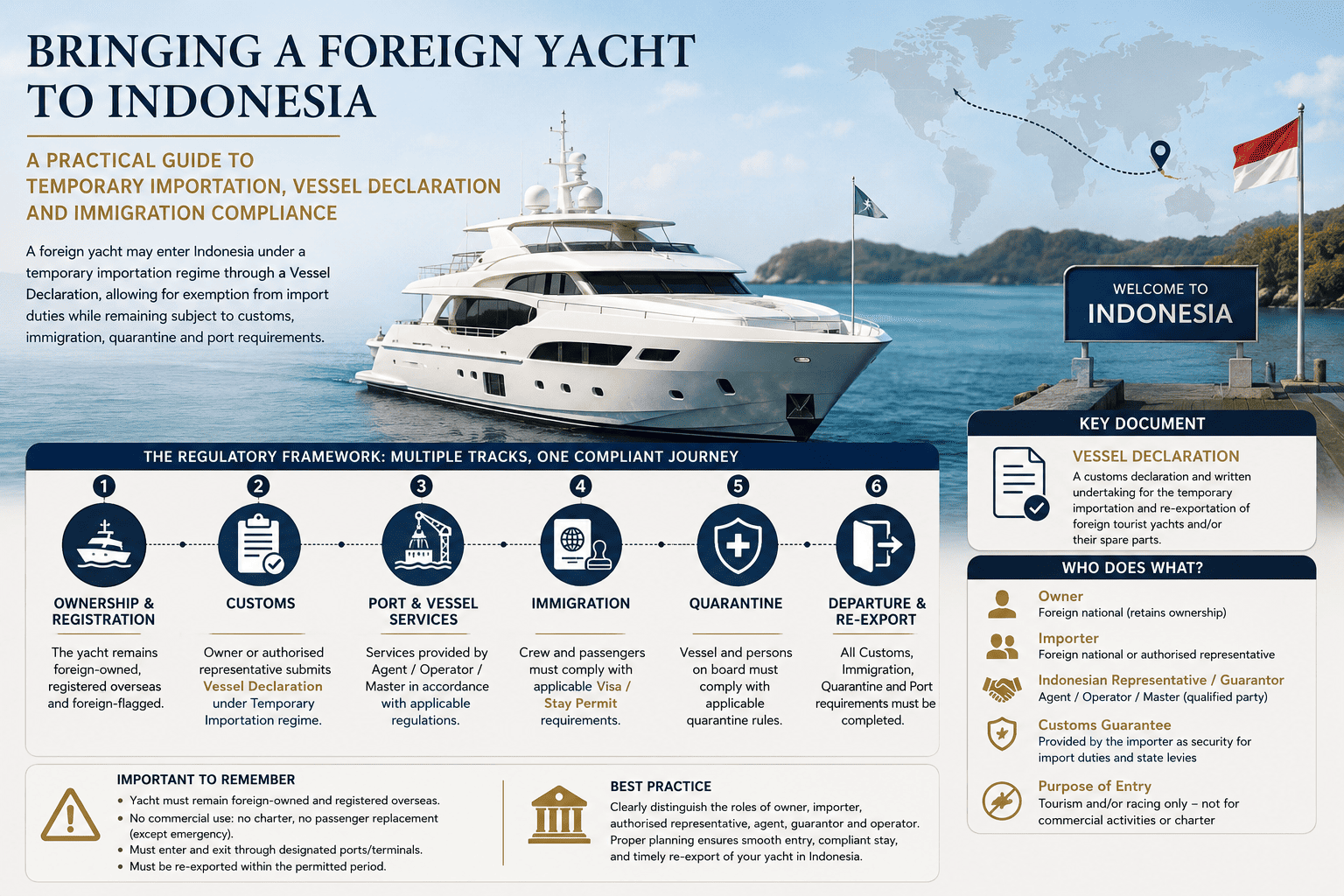
11. How Does the Regulatory Structure Work?
In practice, the entry of a foreign yacht into Indonesia involves several regulatory tracks operating in parallel.
1. Ownership and Registration
The yacht remains:
Foreign-owned + registered overseas + foreign-flagged
2. Customs
The owner or authorised representative undertakes:
Vessel Declaration → Temporary Importation → Customs Clearance
3. Port and Vessel Services
The yacht receives services through:
Agent / Operator / Master
in accordance with the capacity permitted under the applicable regulations.
4. Immigration
Crew members and passengers satisfy the applicable:
Visa / Stay Permit requirements
5. Quarantine
The vessel and persons on board comply with:
Applicable quarantine requirements
6. Departure
Before the yacht leaves Indonesia, the relevant:
Customs + Immigration + Quarantine + Port Requirements
must be duly completed in accordance with the applicable regulations.
12. What Can and Cannot an Indonesian Company Do?
For an Indonesian company assisting a foreign yacht owner, the most important distinction is between facilitation and ownership or importation.
An Indonesian company may act as a vessel agent or guarantor, provided that it satisfies the applicable qualifications and requirements.
However, an Indonesian company cannot simply replace the foreign national as the owner or importer and continue to claim the temporary importation facility applicable to a foreign yacht.
The temporary importation framework requires the yacht to remain registered overseas, owned by a foreign national, and imported by that foreign national or their authorised representative.
Conclusion
Indonesia provides a relatively structured mechanism for foreign yachts to enter Indonesian territory temporarily through the Vessel Declaration framework.
Under this regime, foreign yachts satisfying the applicable requirements may benefit from an exemption from import duties, while retaining their status as vessels owned and registered outside Indonesia and remaining subject to the obligation to be re-exported.
However, the customs facility does not operate in isolation.
Customs, immigration, port and quarantine requirements are interconnected, but each is governed by its own regulatory framework and compliance requirements.
Accordingly, for foreign yacht owners and Indonesian companies assisting with the entry of a vessel, the relevant legal question is not simply “Can the yacht enter Indonesia?”
Rather, the more important question is:
“How should the yacht’s ownership, importation, agency arrangements, Vessel Declaration, immigration status and re-export be structured within a single framework that complies with the applicable Indonesian regulations?”
With the appropriate structure, a foreign yacht may enter Indonesia temporarily without transferring ownership to an Indonesian party while making use of the customs facilities available under the temporary importation regime.
Conversely, where the roles of the owner, importer, authorised representative, agent, guarantor and operator are not properly distinguished, the structure may give rise to customs, port-related and immigration compliance risks.
How TAMA Global Mobility Can Assist
TAMA Global Mobility acts as a trusted mobility and compliance partner for foreign yacht owners, operators, and their appointed representatives navigating the practical requirements of bringing a foreign yacht into Indonesia.
Our support includes:
- Yacht Entry & Mobility Assessment, assessing the proposed arrival, stay, and departure arrangements to identify the key administrative, mobility, and regulatory considerations;
- Temporary Importation Support, providing guidance on the practical process and documentation involved in the temporary entry of a foreign yacht into Indonesia;
- Vessel Declaration Support, assisting with the preparation and coordination of the information and documentation required for the Vessel Declaration process;
- Local Agent & Representative Coordination, advising on the coordination of Indonesian agents, vessel representatives, and other local service providers involved in the yacht’s entry and stay;
- Crew & Passenger Mobility Support, providing guidance and coordination on the immigration and mobility arrangements applicable to crew members and passengers;
- Documentation & Process Management, reviewing and coordinating the required documentation to help ensure that the relevant processes are properly organised and completed;
- Stakeholder & Authority Liaison, acting as a central point of contact between the yacht owner, appointed representatives, local agents, service providers, and relevant authorities;
- Stay & Departure Planning, supporting the planning and coordination of the yacht’s continued stay and eventual departure from Indonesia; and
- End-to-End Yacht Mobility Advisory, providing ongoing practical guidance and coordination throughout the yacht’s entry, stay, and departure from Indonesia.
Through a practical, coordinated, and risk-conscious approach, TAMA Global Mobility helps foreign yacht owners and their representatives navigate the administrative, mobility, and regulatory aspects of operating a foreign yacht temporarily in Indonesia.
Disclaimer: Here
– – – ||| – – –
TAMA Global Mobility
WhatsApp: +62 821-1015-402
Email: info@staging.tamaglobalmobility.com
For additional insights on Indonesian immigration compliance and global mobility matters, explore our related publications:
Who Is Responsible for the Immigration Status of a Foreign Worker After Termination of Employment?
Can Foreign Investors Manage Day to Day Business Operations?
Immigration Risks During Mergers and Acquisitions in Indonesia