
23 Aug 2026 · TAMA Insight
Foreign Artists Performing in Indonesia: When Is a Work Permit Required?
Understanding the distinction between permitted performance activities, employment relationships, and Indonesian immigration requirements for foreign artists Foreign artists performing in Indonesia are not automatically required to obtain a…
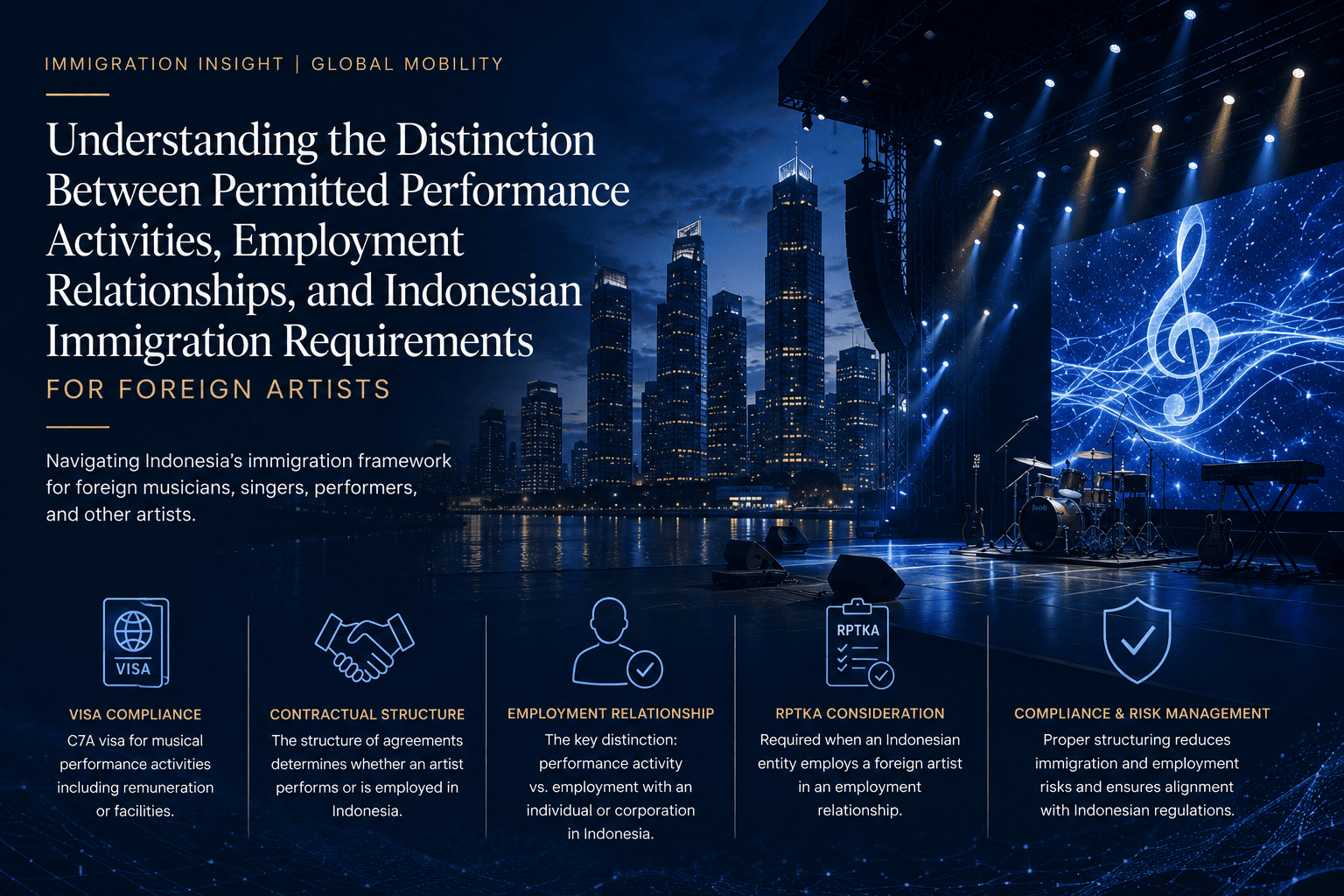
Understanding the distinction between permitted performance activities, employment relationships, and Indonesian immigration requirements for foreign artists
Foreign artists performing in Indonesia are not automatically required to obtain a work permit merely because they receive payment or perform at a commercial event.
The applicable immigration framework distinguishes between permitted short-term activities and activities that constitute employment or an employment relationship with an individual or corporation in Indonesia.
This distinction is particularly relevant for foreign musicians, singers, performers, and other artists entering Indonesia for concerts, festivals, promotional events, and similar activities.
Under Minister of Immigration and Corrections Decree No. M.IP-08.GR.01.01 of 2025 on Visa Classification, Visa C7A may be used for certain activities involving the presentation, display, or performance of works related to music.
Importantly, activities permitted under this category may include:
- engaging in activities related to musical performances;
- undertaking tourism activities, purchasing goods, or visiting family and friends; and
- receiving remuneration or facilities for the activities undertaken.
At the same time, holders of this visa are prohibited from working in an employment relationship with an individual or corporation in Indonesia.
This creates an important distinction:
Receiving remuneration does not automatically mean that a foreign artist is employed by an Indonesian entity.
Accordingly, the appropriate immigration structure depends not merely on whether the artist receives payment, but also on the nature of the activity, the source and structure of the payment, the contractual relationship, and whether the artist actually has an employment relationship with an individual or corporation in Indonesia.
1. Is a Foreign Artist Automatically Considered a Foreign Worker?
The answer depends on the legal structure of the artist’s activities in Indonesia.
Under Indonesia’s manpower framework, a Foreign Worker (Tenaga Kerja Asing or TKA) is generally a foreign national holding a visa with the intention to work in Indonesia.
The concept of an Employer of TKA (Pemberi Kerja TKA) is also connected to the existence of an Indonesian legal entity or another qualifying entity that employs a foreign worker and provides wages or other remuneration.
Accordingly, the fact that a foreign artist performs in Indonesia and receives payment does not, by itself, conclusively establish that the artist has entered into an employment relationship in Indonesia.
The assessment should instead consider:
- who engages or contracts with the artist;
- who is contractually responsible for the performance;
- who pays the artist;
- whether the payment constitutes remuneration under an employment relationship;
- whether the artist is employed by an individual or corporation in Indonesia;
- what activities the artist actually performs in Indonesia; and
- which visa classification applies to those activities.
This distinction is particularly important for international artists engaged by foreign management companies, international promoters, agencies, or other entities outside Indonesia who enter Indonesia only for a limited performance period.
2. C7A and Musical Performance Activities in Indonesia
The current visa classification framework provides a specific category relevant to foreign musical performers.
Under Visa C7A, permitted activities include:
- presenting, displaying, or performing works related to music;
- undertaking activities related to musical performances;
- undertaking tourism activities, purchasing goods, and visiting family or friends; and
- receiving remuneration or facilities for the activities undertaken.
This is significant because the visa framework expressly recognizes that a foreign artist may receive remuneration or facilities while undertaking permitted musical performance activities.
Accordingly, payment received by an artist does not, by itself, transform the activity into prohibited employment.
The key limitation is that the visa holder may not:
work in an employment relationship with an individual or corporation in Indonesia.
Therefore, a foreign musician performing at a concert in Indonesia may potentially fall within the scope of C7A where the activity is structured as a permitted performance activity rather than an employment relationship in Indonesia, while still taking into account the actual contractual and factual structure.
3. The Key Distinction: Performance Activity vs. Employment Relationship
From an immigration compliance perspective, the primary question is not simply:
“Is the foreign artist being paid?”
The more relevant question is:
“Is the foreign artist working in an employment relationship with an individual or corporation in Indonesia?”
This distinction can be critical when structuring international concerts.
For example, the analysis may differ depending on whether:
Structure A — Permitted Performance Activity
A foreign artist is engaged by a foreign management company or promoter, enters Indonesia for a limited musical performance, performs at an event in Indonesia, and receives remuneration or facilities within the scope of the permitted activities under the applicable visa.
This structure may fall within the scope of a permitted visit activity, subject to the specific contractual arrangements and facts.
Structure B — Employment by an Indonesian Entity
An Indonesian company directly employs the foreign artist, determines the artist’s employment terms, provides remuneration as an employee, and establishes an employment relationship in Indonesia.
This raises a substantially different regulatory issue because the activity may fall within Indonesia’s TKA framework.
Accordingly, the distinction should be assessed based on the substance of the arrangement, rather than merely the title of the contract or the fact that the event is short-term.
4. Does Receiving Payment Mean the Artist Requires a Work Permit?
Not necessarily.
This is one of the most important points for event organizers and international artists.
The C7A visa classification expressly permits the holder to receive remuneration or facilities for the activities undertaken.
Accordingly, the existence of payment, by itself, is insufficient to conclude that the artist is unlawfully working in Indonesia.
The relevant question is whether the payment forms part of an employment relationship with an individual or corporation in Indonesia, or whether it constitutes remuneration or facilities associated with an otherwise permitted performance activity.
The contractual and commercial structure should therefore be carefully reviewed before determining the appropriate immigration route.
5. When Does RPTKA Become Relevant?
Where the arrangement constitutes the employment of a foreign worker by an employer in Indonesia, the Indonesian TKA framework becomes relevant.
Under Government Regulation No. 34 of 2021 on the Utilization of Foreign Workers (PP 34/2021), employers intending to employ TKA are generally required to obtain RPTKA Approval, subject to applicable exemptions and specific arrangements.
RPTKA Approval establishes the parameters for the employment of TKA, including:
- the position occupied by the TKA;
- the number of TKA;
- the work location;
- the period of employment; and
- other relevant employment information.
The employer must then ensure that the actual employment of the TKA remains consistent with the approved structure.
Accordingly, where an Indonesian promoter or event organizer is not merely organizing or hosting a foreign artist’s performance but is actually employing the artist in an employment relationship in Indonesia, the company should assess whether RPTKA and work-related immigration status are required.
The fact that a concert lasts only one or two days does not, by itself, eliminate the need for such an assessment.
6. Why Do Short-Term Concerts Require Careful Structuring?
Concerts and music festivals often operate on highly compressed schedules.
A foreign artist may enter Indonesia solely for:
- a single performance;
- several rehearsals;
- a promotional appearance;
- a music festival;
- a series of performances over several days; or
- other activities connected with the event.
However, the short duration of the activity should not be the sole factor in determining immigration status.
Instead, event organizers and parties engaging the artist should assess the actual nature of the activity and the relationship between the artist and the Indonesian parties involved.
A short-term performance may fall within a permitted visit activity.
However, if the arrangement creates an employment relationship with an individual or corporation in Indonesia, a different regulatory framework may apply.
Accordingly, proper structuring from the outset is particularly important.
7. What Activities Are Prohibited Under the C7A Framework?
Although C7A permits certain musical performance activities, the visa also establishes important limitations.
Prohibited activities include:
- undertaking activities outside the permitted scope;
- remaining in Indonesia beyond the authorized period;
- selling goods or services; and
- working in an employment relationship with an individual or corporation in Indonesia.
The final restriction is particularly important for event organizers.
Accordingly, an artist may be permitted to perform music and receive remuneration while simultaneously being prohibited from entering into an employment relationship with an individual or corporation in Indonesia.
This distinction is subtle but legally significant.
Companies should therefore not assume that a C7A visa provides unrestricted authorization to undertake all forms of paid work in Indonesia.
8. The Importance of the Contractual Structure
For international events, the contractual structure can materially affect the immigration analysis.
Before the artist enters Indonesia, the parties should consider:
- whether the artist is engaged directly or through a foreign management company;
- who the contractual parties are;
- who pays the artist;
- where the payment obligation arises;
- whether the Indonesian promoter is merely organizing or hosting the event;
- whether the Indonesian entity exercises employment-like control over the artist;
- whether the artist is required to provide services beyond the permitted performance activity;
- whether the artist performs at multiple locations in Indonesia; and
- whether additional commercial activities are undertaken in Indonesia.
The substance of these arrangements should be considered together with the applicable visa classification.
The objective is not to artificially circumvent the TKA framework, but to ensure that the immigration and employment structure accurately reflects the actual commercial arrangement.
How TAMA Global Mobility Can Support
TAMA Global Mobility supports international artists, event organizers, promoters, production companies, and businesses in assessing immigration and foreign worker requirements in Indonesia.
Our services may include:
- assessing whether a foreign artist’s activities fall within a permitted visit visa category;
- assessing the suitability of C7A for musical performance activities;
- assessing whether an arrangement may create an employment relationship with an individual or corporation in Indonesia;
- reviewing artist, promoter, management company, and event organizer contracts from an immigration compliance perspective;
- assessing whether RPTKA and work-related immigration arrangements are required;
- reviewing the scope of activities planned during the artist’s stay in Indonesia;
- identifying potential immigration and employment compliance risks before arrival; and
- assisting in structuring cross-border artist and event arrangements in accordance with the applicable Indonesian regulatory framework.
TAMA Global Mobility helps international companies and event organizers navigate the intersection between immigration, foreign worker regulation, and cross-border mobility, ensuring that the immigration structure reflects the actual commercial arrangement and activities undertaken in Indonesia.
Disclaimer: Here
– – – ||| – – –
TAMA Global Mobility
WhatsApp: +62 821-1015-402
Email: info@staging.tamaglobalmobility.com
For additional insights on Indonesian immigration compliance and global mobility matters, explore our related publications:
Indonesia’s 2026 Draft Manpower Bill: Key Considerations for Employers of Foreign Workers
What Happens to an Investor KITAS When Shares Are Sold?
Who Is Responsible for the Immigration Status of a Foreign Worker After Termination of Employment?