
24 Aug 2026 · TAMA Insight
Starting a Maritime Tourism Business in Indonesia: Key Licensing and Foreign Investment Considerations
Indonesia’s maritime tourism sector continues to attract foreign investors, particularly for businesses involving inter-island tourism, private boat charters, snorkeling and diving activities, fast-boat transportation, and maritime tourism packages.…
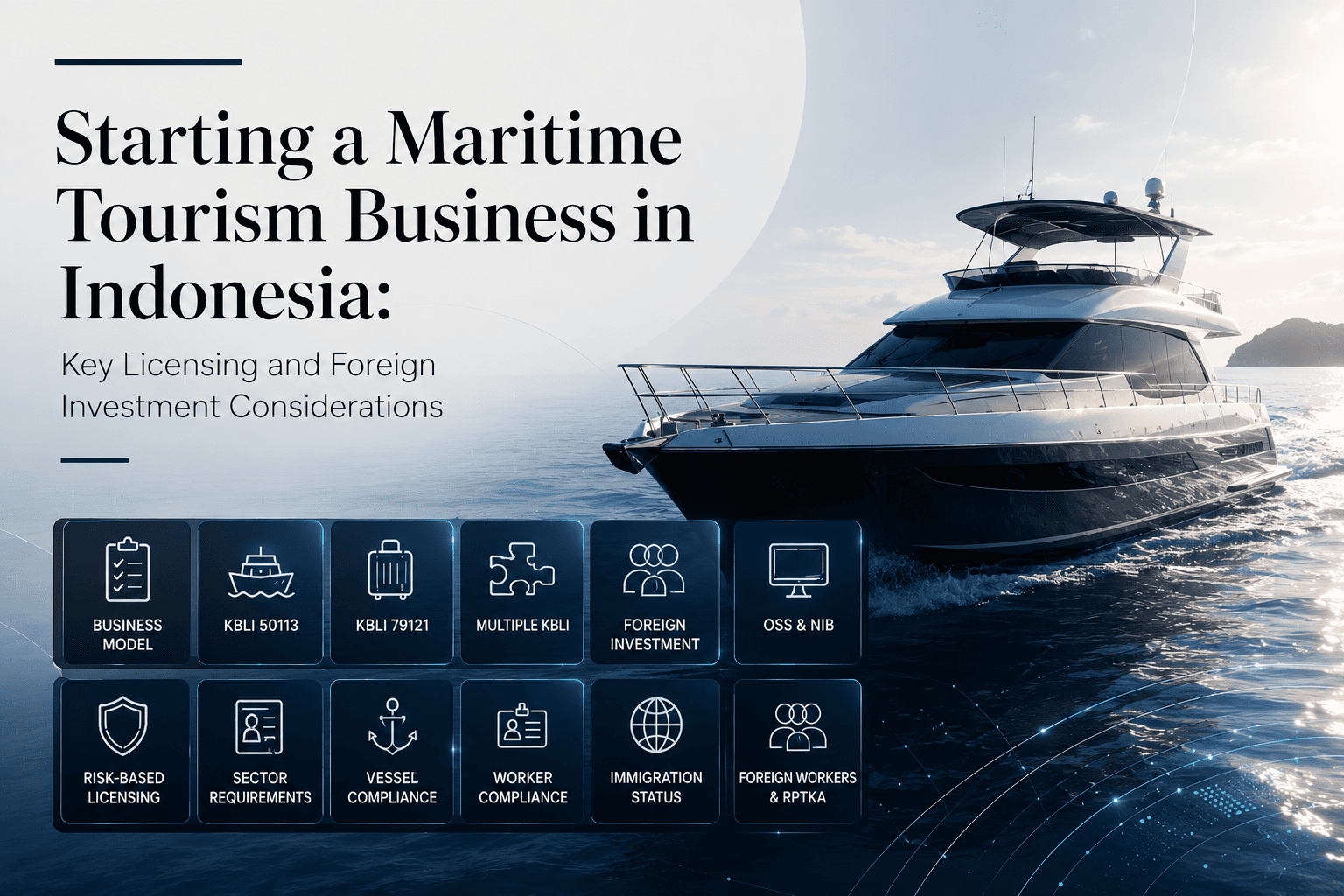
Indonesia’s maritime tourism sector continues to attract foreign investors, particularly for businesses involving inter-island tourism, private boat charters, snorkeling and diving activities, fast-boat transportation, and maritime tourism packages.
However, establishing a maritime tourism business in Indonesia involves more than incorporating a company and obtaining a Business Identification Number (NIB). Foreign investors need to comprehensively consider the business structure, KBLI classification, foreign investment requirements, OSS licensing, tourism-sector requirements, sea transportation regulations, vessel requirements, as well as the immigration status of foreign workers.
Ultimately, the appropriate licensing structure will depend on the business model and the activities actually carried out in Indonesia.
1. Start with the Business Model
The first step is to clearly determine the business activities to be conducted.
For example, a maritime tourism business may:
- sell tickets for tourist boat transportation;
- operate its own vessels;
- provide private boat charters;
- organize private or shared island tours;
- provide snorkeling or diving activities;
- provide tour guides;
- provide hotel transfers;
- provide admission tickets to tourist destinations; or
- combine transportation, accommodation, and other tourism activities into a single package.
These activities may be subject to different KBLI classifications and licensing requirements.
Therefore, investors should determine the substance and business model before determining which KBLI classifications should be used.
2. KBLI 50113, Domestic Sea Transportation for Tourism
For businesses whose primary activity is transporting tourists by sea, KBLI 50113, Domestic Sea Transportation for Tourism, is one relevant classification.
This KBLI covers transportation activities for tourism or recreation by sea and/or maritime tourism, including the rental of sea transportation for tourism together with its operators.
This KBLI may be relevant for businesses that:
- operate tourist vessels;
- transport tourists between islands;
- operate fast boats for tourism activities;
- provide private boat charters with crew; or
- provide sea transportation as the primary maritime tourism service.
For example, a company operating a fleet of vessels to transport tourists from Jakarta or Bali to various islands should consider KBLI 50113 as part of its licensing structure.
However, the use of this KBLI also means that the company needs to consider sector-specific requirements in the sea transportation sector, rather than relying solely on general business registration through OSS.
3. KBLI 79121, Travel Agency Activities
A different analysis applies where a company does not merely provide sea transportation but also arranges and sells travel packages.
KBLI 79121 covers the planning and preparation of travel packages as well as the organization and direct sale of travel packages to tourists or through travel agents.
This KBLI may also cover the provision of:
- tour guide services;
- tourist transportation;
- accommodation;
- food;
- admission tickets to tourist attractions; and
- other components forming part of a travel package.
Accordingly, for a business selling packages such as:
boat transportation + snorkeling + lunch + admission ticket + tour guide + other tourism activities
KBLI 79121 may be relevant as an additional KBLI alongside sea transportation activities.
The main distinction is:
Sea transportation business:
The company essentially provides sea transportation services for tourism.
Travel agency business:
The company arranges and sells various components as a single travel product or package.
4. One Business May Require More Than One KBLI
One important consideration for foreign investors is that a company should not determine its KBLI solely based on its marketing description.
A maritime tourism company may simultaneously conduct:
- tourist vessel transportation;
- private charters;
- travel packages;
- snorkeling or diving;
- tour guide services;
- hotel transfers; and
- other tourism services.
Accordingly, the company may need to assess several KBLI classifications if its business activities genuinely encompass multiple activities.
The determination of KBLI should be based on the actual business activities conducted and the activities generating revenue for the company.
5. Foreign Investment and PT PMA
Foreign investors seeking to establish a maritime tourism business also need to determine whether the relevant activities may be conducted through a PT PMA and whether there are any foreign ownership restrictions or specific investment requirements.
The investment structure should be reviewed together with:
- the KBLI classifications to be used;
- foreign ownership requirements;
- investment value requirements, where applicable;
- shareholder structure;
- capital structure;
- location of business activities; and
- sector-specific licensing requirements.
This is important because selecting a KBLI is not merely an administrative matter. Certain KBLI classifications may affect the eligibility for foreign ownership and the company’s licensing obligations.
6. OSS, NIB and Risk-Based Business Licensing
Once the business activities have been determined, the company needs to obtain its business licensing through the Online Single Submission (OSS) system.
The current risk-based business licensing framework is regulated, among others, under Government Regulation No. 28 of 2025, which replaced Government Regulation No. 5 of 2021.
Depending on the risk level and characteristics of the business activities, a company may be required to obtain not only an NIB, but also additional licenses, certifications, or sector-specific requirements.
Accordingly:
Having an NIB does not necessarily mean that all operational requirements have been fulfilled.
Investors need to ensure that all requirements applicable to each KBLI have been satisfied before commencing business activities.
7. Vessel and Sea Transportation Requirements
For companies operating their own vessels, corporate licensing requirements must be considered together with the legal status and compliance of the vessels.
Matters that may need to be considered include:
- ownership or operational control of the vessel;
- Indonesian flag requirements;
- vessel seaworthiness;
- vessel registration;
- safety certification;
- crew requirements;
- vessel specifications; and
- applicable sea transportation approvals or licenses.
This is particularly important for companies using KBLI 50113.
Accordingly, investors should not assume that establishing a PT PMA and obtaining an NIB automatically grants the right to operate tourist vessels in Indonesian waters.
Corporate licensing and vessel compliance should be analyzed as an integrated regulatory framework.
8. Immigration Status of Foreign Investors
Foreign investors also need to distinguish between their capacity as investors/shareholders and their capacity as employees or operational personnel.
A foreign national investing in an Indonesian company requires an appropriate immigration status corresponding to the activities they undertake in Indonesia.
However, shareholder status does not automatically authorize a foreign investor to perform all operational functions of the company.
For example, a separate analysis may be required where the foreign investor intends to:
- manage day-to-day operations;
- serve as a manager;
- operate or supervise vessels;
- provide technical services;
- provide training to employees; or
- perform other operational functions.
Therefore, the corporate structure, investment status, and immigration status should be analyzed together.
9. Foreign Workers and RPTKA
Where an Indonesian company intends to employ foreign nationals as managers, experts, maritime professionals, or in other positions, the company needs to assess the applicable foreign worker regulations.
This may include:
- whether the position may be occupied by a foreign worker;
- RPTKA requirements;
- the stay permit related to employment;
- position and work location;
- employment period; and
- compliance with Indonesian employment regulations.
Investors should avoid assuming that investor immigration status automatically serves as a substitute for the company’s compliance with foreign worker requirements.
How TAMA Global Mobility Can Assist
TAMA Global Mobility can assist foreign investors and maritime tourism businesses with:
- PT PMA establishment and foreign investment structuring;
- KBLI review based on the business model;
- OSS, NIB and business licensing;
- analysis of tourism-sector licensing;
- analysis of KBLI 50113 and 79121;
- review of vessel and sea transportation legal requirements;
- foreign ownership analysis;
- RPTKA and foreign worker compliance;
- immigration matters for investors and foreign workers;
- preparation and review of charter, supplier, partnership and other commercial agreements; and
- ongoing corporate and regulatory compliance support.
Disclaimer: Here
– – – ||| – – –
TAMA Global Mobility
WhatsApp: +62 821-1015-402
Email: info@staging.tamaglobalmobility.com
For additional insights on Indonesian immigration compliance and global mobility matters, explore our related publications:
Foreign Artists Performing in Indonesia: When Is a Work Permit Required?
Indonesia’s 2026 Draft Manpower Bill: Key Considerations for Employers of Foreign Workers
What Happens to an Investor KITAS When Shares Are Sold?
Who Is Responsible for the Immigration Status of a Foreign Worker After Termination of Employment?